
Corrugated Cardboard Machine Basics: How a Complete Production Line Turns Rolls into Ready Boxes
A corrugated cardboard machine is an industrial system that converts rolls of paper into corrugated board and then into finished cartons. First-time buyers often search for a single machine, but a complete corrugated cardboard production line is actually a series of synchronized units: unwinding, splicing, corrugating, bonding, drying, slitting, printing, cutting, folding, and stacking. This guide explains each stage in plain language, defines the key equipment names, and gives you a practical framework for evaluating a line before you request a quote.
What Is a Corrugated Cardboard Machine?
A corrugated cardboard machine is a piece of equipment used to produce corrugated board from one or more layers of paper. In the packaging industry, the term is also used to describe a complete corrugated cardboard production line that combines multiple machines to make sheets and boxes at high speed. A single machine can perform one function, such as printing or slotting; a production line integrates them into one continuous process.
LLY PACK (HK) CO., LIMITED is a manufacturer specializing in corrugated machines and high-speed corrugated cardboard production lines. The company was established in 2024, is located in Foshan City, Guangdong Province, and operates with an R&D team of 30 engineers. Its main products include Corrugated Belt, Corrugating Roll, Single Facer, Auto Splicer, and Corrugated Paper Board Production Line. Export business accounts for 100% of total sales, with major markets in South America, Southeast Asia, Africa, the Mid East, and the domestic Chinese market. Its machines have been exported to over 40 countries, with more than 3,500 successful installations worldwide.
Why Understanding the Full Line Matters
Many equipment searches begin with the general query "corrugated cardboard machine." The challenge is that a corrugator alone does not produce a finished box. To operate a carton plant, you need several downstream converting machines as well. Understanding the full line helps you avoid three common problems: buying incompatible machines, underestimating floor space and utility requirements, and missing auxiliary equipment that affects output quality.
The global corrugated box making machine market was valued at USD 2.21 billion in 2024 and is projected to reach USD 3.36 billion by 2033, with a CAGR of 4.8% from 2025 to 2033, according to Grand View Research. Automatic machines already account for about 55.6% of global demand by automation level. That shift toward automation explains why buyers increasingly evaluate complete lines rather than individual machines.
Main Stages of a Corrugated Cardboard Production Line
A typical corrugated cardboard production line can be divided into two major sections: the wet end and the dry end. The wet end forms the board; the dry end cuts and prepares it for printing and box-making.
1. Paper Reel Stands and Conveying
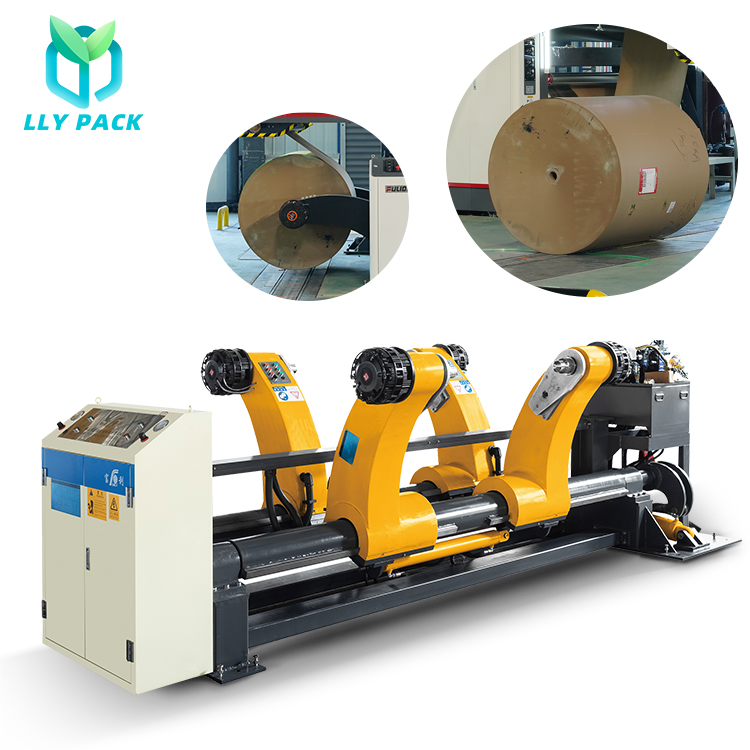
The line starts with paper rolls. A hydraulic reel stand, such as the LLY PACK Hydraulic Reel Stand model HRS-1, supports the paper roll and keeps it rotating at the correct tension. The HRS-1 handles paper roll diameters from 300 mm to 1,500 mm and has a rated power of 3.7 kW. The Paper Reel Cutter model PRC-1, a Paper Reel Slitter, cuts paper width from 2 cm to 4 m, with a paper recycling ratio of 95%.
To keep the corrugator running without frequent stops, many lines use a paper reel conveyor. LLY PACK's Paper reel conveyor model PRC-1 is a Motorized Track & Dolley system operating at 220 V with a weight of 200 kg. A conveyor reduces the physical effort of moving heavy reels into position.
2. Automatic Splicing
An Auto Splicer joins the end of an expiring paper roll to the start of a new roll without stopping the line. LLY PACK's Auto Splicer model AS-1 operates at splicing speeds of 300 to 400 m/min and handles paper widths from 1,200 to 2,550 mm. It is designed for liner papers from 50 g/m² to 350 g/m². For high-continuity operations, the splicer is essential because it eliminates downtime during roll changes.
3. Single Facer and Corrugating Roll
The Single Facer is the heart of the corrugating process. It takes a medium paper, passes it between corrugating rolls to form the flute profile, and bonds it to a flat liner. The LLY PACK Single Facer model SF-1 is a Corrugated Machine with a design speed of 250 m/min, a web width of 1,400 to 2,300 mm, and flute rolls of 380 mm diameter. The precision of the corrugating rolls determines the flute shape and board strength.
Corrugating rollers are also sold as wear parts for existing lines. LLY PACK lists Corrugating Roll as one of its main products, reflecting the need for regular replacement due to wear.
4. Glue Application and the Double Facer Section
After the single-faced web is formed, a glue machine applies adhesive to the flute tips. The web is then pressed against another liner in the double facer section, which is heated and belted to cure the bond. Temperature and belt condition directly affect flat crush and bond quality.
The Corrugator line Glue kitchen model CGK-1 is a steel glue kitchen for corrugator lines, intended for the corrugated carton packaging industry. It prepares and supplies starch adhesive to the corrugator. The Double Facer Belt is another key consumable; LLY PACK manufactures Corrugated Belt as part of its product range.
5. Slitting and Scoring
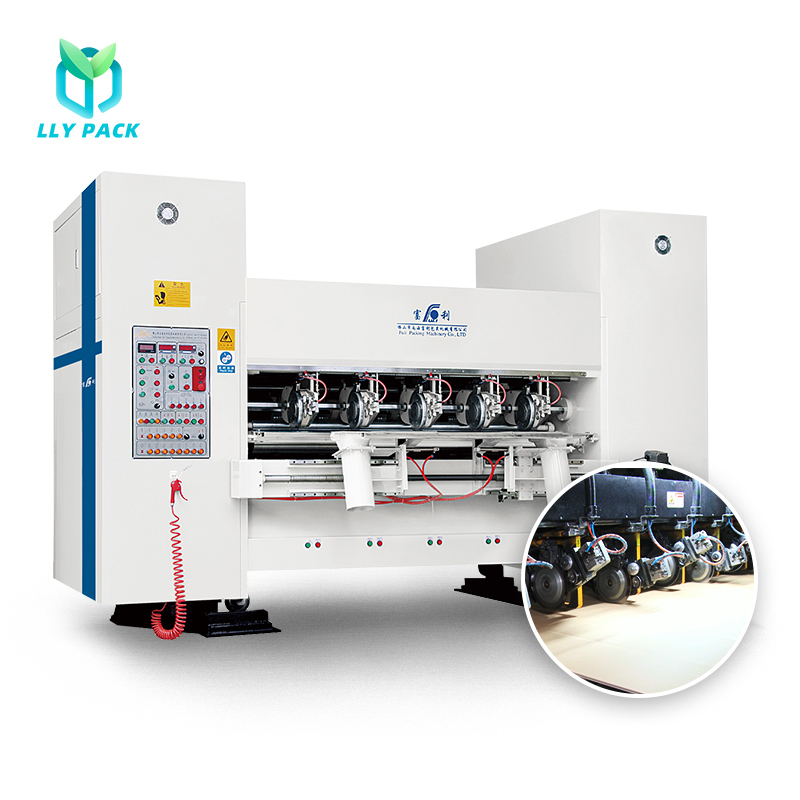
Once the board is formed, it must be cut into widths and creased for later folding. A Slitter scorer performs both functions. The LLY PACK Slitter scorer model SSC-1 is a Thin Blade Slitter Scorer Machine with a production capacity of 630 to 900 m/min, a maximum paper width of 2,200 mm, and a minimum slitting width of 150 mm. The outside diameter of the slitting blade is 260 mm; the scoring wheel is 190 mm.
6. Stacking and Feeding
After slitting and scoring, the boards are stacked. A Stacker model STA-1 is a Corrugated Cardboard Stacking Machine that collects sheets in neat piles. Downstream, a Pre feeder model PF-1 is an Automatic Pre-Feeder for corrugated sheets; it feeds sheets into the printer or die cutter at a maximum speed of 280 sheets/min and handles sheet sizes from 300 x 600 mm to 1,600 x 3,000 mm.
Converting Equipment: From Board to Finished Box
A corrugated cardboard production line and its supporting equipment do not stop at the sheet stage. To produce cartons, you also need printing, die-cutting, folding, gluing, stitching, and bundling equipment. These machines are part of the broader corrugated cardboard machine family.
Flexo Printing
A Flexo printer model FP-1 is a Flexo Printer Slotter for the corrugated box packaging industry. It has a maximum equipment speed of 350 sheets/min, a maximum feed size of 1,600 x 3,600 mm, a maximum printing size of 1,600 x 3,560 mm, and a maximum slotting depth of 400 mm. The FP-1 combines printing, slotting, and creasing in one machine.
For flexo plate maintenance, the Flexo graphic Stereo Washing Machine model FGSW-1 is a washing machine made of steel for the corrugated box packaging industry. It operates with a wash speed of 300 to 5,000 mm/min and has a water tank capacity of 150 L.
Die Cutting and Slotting
A Slotter Die cutter model SDC-1 is a Die Cutting Machine for Corrugated Box Cardboard. It handles a maximum paper size of 1,100 x 1,600 mm, a minimum paper size of 450 x 600 mm, a maximum die-cutting size of 1,080 x 1,580 mm, and a die-cutting pressure of 350 tons. The maximum die-cutting speed is 5,000 impressions per hour.
Folding and Gluing
A Folder gluer model FG-1 folds and glues carton blanks into finished boxes. It has a maximum gluing speed of 110 m/min, a maximum blank size of 1,200 x 2,600 mm, a minimum size of 300 x 750 mm, and a 16 kW motor. It uses suction belt feeding and a top-fold configuration.
Stitching and Bundling
A Stitching machine model STM-1 is a semi-automatic double-piece stitcher for the corrugated carton packaging industry. It stitches at 450 nails/min with a stitching pitch of 30 to 140 mm and supports 1 to 99 stitches per box. A Strapping Machine model SM-1 then bundles finished cartons with PP straps. The SM-1 reaches 35 bundles/min with a single strap and 21 bundles/min with double straps, with a transport speed of 15 to 60 m/min and a maximum bundle weight of 40 kg.
For smaller bundles, the Boundle Machine model BM-1 is a Tying machine. The Wrapping machine model WM-1 is a Film Wrapping Machine for protecting pallet loads; it has a maximum walking speed of 75 m/min and a rated duty cycle of 8-10 hours.
Material Handling and Waste Management
A Cardboard Conveyor model CC-1 is a Robotic Palletizer designed for the corrugated carton packaging industry. It handles bundles with a maximum weight of 3,000 kg, a maximum carton size of 1,500 W x 1,200 L x 250 H mm, and a stacking height of 1,800 mm. A Waste paper baler model WPB-1 compresses production waste into dense bales; it has a bale density of 400-500 kg/m³ and a capability of 3-4 tons per hour.
Laminating and Quality Testing
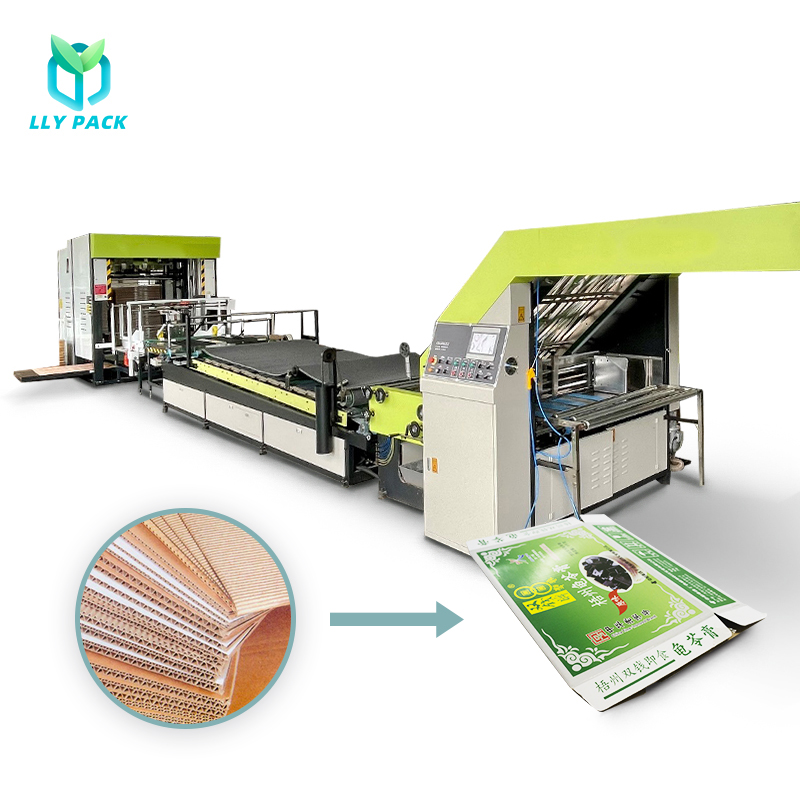
A Cardboard Laminater model CL-1 mounts a printed top sheet onto corrugated board. It accepts top sheet thicknesses from 128 g/m² to 450 g/m² and bottom sheets from 0.5 mm to 10 mm, with a maximum working speed of 148 m/min and lamination error of ±0.5 mm to ±1.5 mm.
A Carton testing instrument model CTI-1 is a Carton Cardboard Tester that measures burst strength and crush resistance. Its BST measuring range is 250 to 5,600 kPa, its crush range is 60-3,000 N, and its thickness range is 0.01-60 mm, with accuracy of ±0.5% FS. Quality testing is important not only for internal control but also for compliance with standards such as ISO 3037:2022 for edgewise crush resistance.
Complete Line Specification Example: CCPL-1
LLY PACK's Corrugated Cardboard Production Line model CCPL-1 is a corrugated carton production machine with a maximum mechanical speed of 300 m/min and a production line width of 1,400 to 2,800 mm. The line uses steam heating at a steam pressure of 10 kg/cm² and requires approximately 110 m (L) x 14 m (W) x 6.5 m (H) of space. Depending on line speed, a boiler of 2, 3, or 4 MT/H is required.
For a buyer evaluating a complete line, these dimensions are practical starting points. A line is not a single footprint; it is a series of connected machines, and the building must accommodate both the equipment length and the space needed for reel storage, work-in-progress, finished goods, and maintenance access.
Step-by-Step: How to Evaluate a Corrugated Cardboard Machine
Use this checklist when comparing equipment from different suppliers.
Step 1: Define output and board grade
Start with the maximum line speed and width you need. A line rated for 300 m/min is appropriate for high-volume production; a lower-speed line may be enough for a regional plant. Also define the board grades: single wall, double wall, or heavy-duty multi-layer board.
Step 2: Check the wet-end components
Verify the reel stand range, splicer speed, single facer design speed, and glue kitchen capacity. The wet end determines how continuously the line can run. An auto splicer rated for 300-400 m/min should match or exceed the corrugator speed.
Step 3: Verify the dry-end capabilities
Check the slitter scorer's maximum width and minimum slitting width, the stacker's maximum stacking height, and the prefeeder's speed. These machines must handle the same board width as the corrugator.
Step 4: Evaluate converting equipment separately
The corrugator produces board; the converting line produces boxes. Match the flexo printer, die cutter, folder gluer, and stitcher to your box sizes and order volumes. If you produce both simple and complex cartons, you may need both a flexo printer slotter and a die cutter.
Step 5: Plan for auxiliaries and testing
Add the laminater, strapping machine, wrapping machine, waste paper baler, and carton testing instrument to your budget. These machines represent a smaller investment than the corrugator, but they are necessary for complete production.
Use Cases for a Complete Corrugated Line
Case 1: Export carton plant entering high-volume e-commerce packaging
A plant in Southeast Asia or South America serving e-commerce needs consistent B-flute and C-flute sheets in multiple sizes. The required equipment includes a corrugator with an auto splicer, a slitter scorer, a stacker, a flexo printer slotter, a folder gluer, and a strapping machine. Because e-commerce orders fluctuate, the line should be able to switch sizes quickly.
Case 2: Industrial box producer with heavy-duty board demand
A producer making heavy boxes for appliances or auto parts needs high-burst-strength board. The line should include a precise glue kitchen, a strong double facer section, a slotter die cutter for thick board (0.5-5 mm), and a carton testing instrument to verify strength before delivery.
Case 3: Small plant upgrading from manual to semi-automatic production
A smaller plant may not need a 300 m/min corrugator. It can start with a lower-speed line, a semi-automatic stitcher, and a manual prefeeder. The decision depends on projected volume, labor cost, and order mix. The key is to choose equipment that can be expanded later.
Comparison Table: Key LLY PACK Machines in a Corrugated Line
| Stage | Machine | Model | Key Specification |
|---|---|---|---|
| Unwinding | Hydraulic Reel Stand | HRS-1 | Paper roll dia. 300-1,500 mm; 3.7 kW |
| Splicing | Auto Splicer | AS-1 | 300-400 m/min; paper width 1,200-2,550 mm |
| Corrugating | Single Facer | SF-1 | 250 m/min design speed; web 1,400-2,300 mm |
| Adhesive | Corrugator line Glue kitchen | CGK-1 | Customized, steel |
| Cutting | Slitter scorer | SSC-1 | 630-900 m/min; max width 2,200 mm |
| Feeding | Pre feeder | PF-1 | 280 sheets/min; sheet up to 1,600 x 3,000 mm |
| Printing | Flexo printer | FP-1 | 350 sheets/min; print 1,600 x 3,560 mm |
| Die Cutting | Slotter Die cutter | SDC-1 | 350 tons pressure; 5,000 i.p.h. |
| Folding/Gluing | Folder gluer | FG-1 | 110 m/min; max size 1,200 x 2,600 mm |
| Stitching | Stitching machine | STM-1 | 450 nails/min; pitch 30-140 mm |
| Bundling | Strapping Machine | SM-1 | 35 bundles/min; max bundle 40 kg |
| Palletizing | Cardboard Conveyor | CC-1 | Max bundle 3,000 kg; stacking height 1,800 mm |
| Waste | Waste paper baler | WPB-1 | 3-4 tons/hour; bale density 400-500 kg/m³ |
| Testing | Carton testing instrument | CTI-1 | BST 250-5,600 kPa; crush 60-3,000 N |
Global Standards Affecting Corrugated Cardboard Machines
Two standards are frequently cited in corrugated board purchasing contracts: ISO 3037:2022 and the FEFCO Good Manufacturing Practice (GMP). ISO 3037:2022 specifies a method for determining edgewise crush resistance, which is a key indicator of board stacking strength. FEFCO GMP covers good manufacturing practice for corrugated board production. For buyers exporting to the EU, CE marking and standards such as EN ISO 12048 for compression testing are relevant compliance considerations.
These standards do not replace machine specifications, but they help you evaluate whether a supplier is capable of producing board that meets customer requirements. When discussing quality with a manufacturer, ask how its line controls flute profile, bond quality, and edge crush.
Corrugated Cardboard Machine: Common Buyer Questions
What does a corrugated cardboard machine do?
A corrugated cardboard machine converts paper rolls into corrugated board. In a complete line, it includes unwinding, splicing, single facer, double facer, slitting, scoring, stacking, and often printing and converting stages to produce finished cartons.
What is the difference between a single facer and a complete corrugated cardboard production line?
A Single Facer forms the medium paper into a fluted shape and bonds it to one liner to create single-faced board. A complete corrugated cardboard production line includes the single facer plus other stations such as the double facer, slitter scorer, stacker, and auxiliary equipment, producing a finished board or box ready for downstream use.
What specifications matter most when comparing corrugated cardboard machines?
Speed, width, board grade capability, and changeover flexibility are the primary specs. For example, the LLY PACK CCPL-1 line has a maximum mechanical speed of 300 m/min and a width range of 1,400-2,800 mm. The single facer design speed and splicer speed also determine continuous output. Verify these against your production target.
What auxiliary equipment is needed for a complete corrugated cardboard machine line?
A typical line includes a hydraulic reel stand, auto splicer, paper reel cutter, paper reel conveyor, glue kitchen, single facer, slitter scorer, prefeeder, flexo printer, slotter die cutter, folder gluer, stitcher, strapping machine, cardboard conveyor, waste paper baler, and carton testing instrument.
How much space does a corrugated cardboard production line require?
Space depends on line speed, width, and auxiliary equipment. As an example, the LLY PACK CCPL-1 line requires about 110 m (L) x 14 m (W) x 6.5 m (H). This does not include converting machines, reel storage, or finished goods space, so plan the building layout before procurement.
Conclusion
A corrugated cardboard machine is not a single purchase; it is an interconnected system of machines that together convert paper rolls into shippable boxes. First-time buyers should approach the purchase as a line decision: define the output speed and width, select the wet-end components carefully, match the dry-end machines to your converting needs, and budget for auxiliary and testing equipment. Understanding each stage also makes it easier to discuss specifications with a supplier and compare proposals.
Manufacturers such as LLY PACK (HK) CO., LIMITED supply both individual machines and complete corrugated cardboard production lines. Because LLY PACK exports to over 40 countries and has completed more than 3,500 installations, its engineering team can provide reference layouts and specifications for emerging markets. For a more detailed review of the full LLY PACK portfolio, download the company brochure.
Need help sizing a corrugated cardboard production line?
Email christina@lycorrugated.com or WhatsApp +86 13763260555 for line layouts, specifications, and pricing.
Have Questions or Need More Details?
Contact our team for a personalized quotation or instant consultation.
Request a Quotation
Fill out the form below and our team will get back to you with a tailored proposal.
WhatsApp Direct Chat
Prefer to chat in real-time? Message us on WhatsApp for instant assistance & quick answers.
- Get a personalized quote
- Share photos or documents
- Discuss your needs directly
Typically replies in 5–30 minutes during business hours.