
Corrugated Line Troubleshooting: Match Anilox Rollers, Blades & Anvil Covers to the Symptom
Corrugated Line Troubleshooting: Match Anilox Rollers, Blades & Anvil Covers to the Symptom
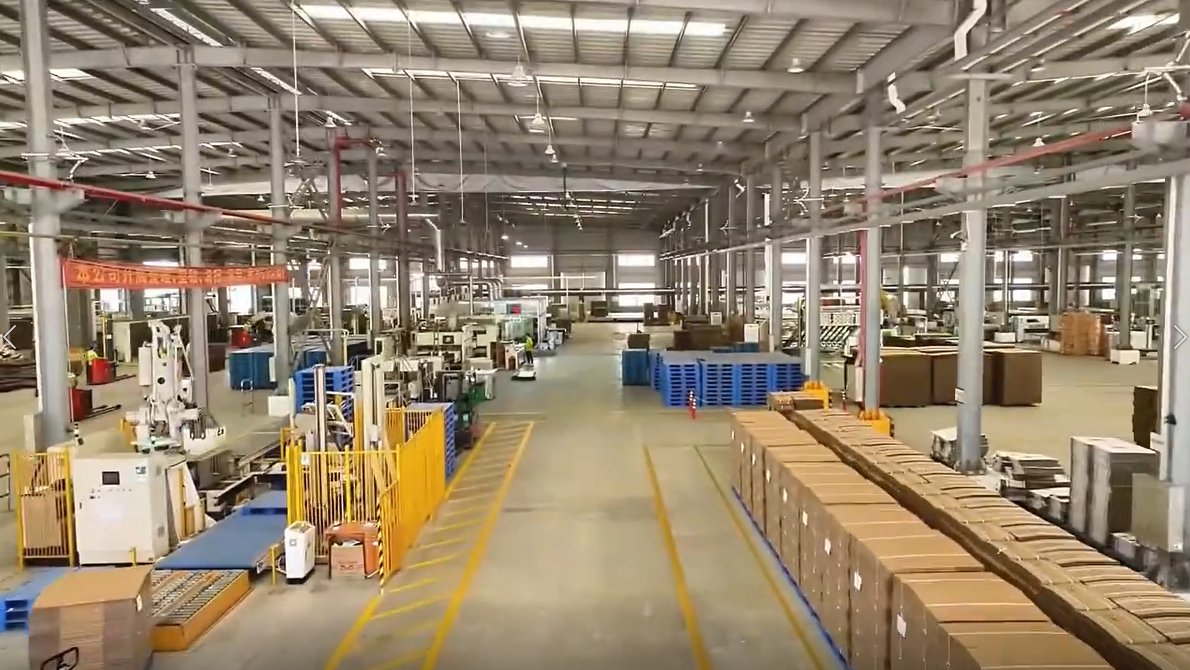
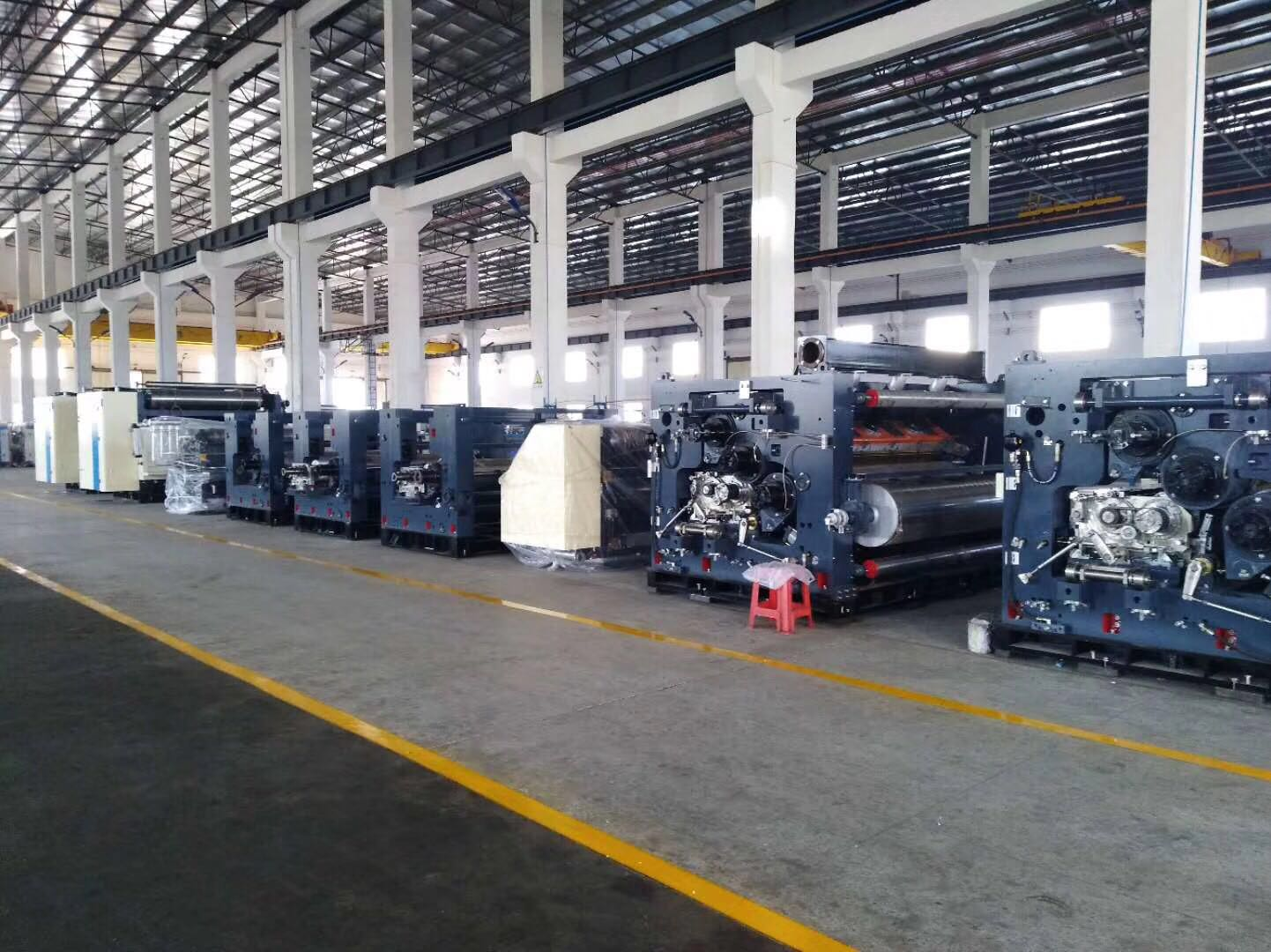
A carton factory floor: the place where a symptom is first seen, and where the part category has to be isolated before an order is placed.
A flexo printer begins laying down uneven ink across the sheet. A slotter starts leaving whiskers on one edge. A die-cutter marks board it used to cut cleanly. Each event reaches the maintenance desk as a part question, and each can be answered wrongly in the same way: by ordering whatever was replaced last time instead of the part the symptom actually points to. Symptom-first troubleshooting treats the fault as the search key and the part name as the answer, not the other way round.
This guide maps print, cutting, wear, tension and hot-section symptoms to categories of corrugated machine parts - the Printing Anilox Roller, Slitting Blade, Slotting Blade, NC Cut-off Blade, Rotary Die Board, Anvil Cover Rubber, Creaser Wheel, No Crush Wheel and the supporting pneumatic, hose and belt components - then sets out the checks and drawing data that should exist before a replacement is quoted. It does not replace the machine manufacturer's settings and tolerance documentation; where the supplied product specification stops, this article says so rather than filling the gap.
Why the Symptom, Not the Parts List, Should Set the Order
A part name identifies a catalogue item. A symptom identifies a station, a failure mode and a set of possible causes - and those causes rarely sit in one category. Uneven printing can originate in ink supply, in ink metering at the anilox roller, in the plate, in impression setting, or in the board itself. A ragged slit edge can come from a dull slitting blade, from incorrect blade seating, from a clamp that has shifted, or from a paper grade the line is not set for. Ordering before that separation turns a diagnosis problem into a stock problem: the new part arrives, the symptom stays, and the original component becomes a spare with no confirmed fault.
The sequence that survives production pressure is short. Describe the symptom precisely, separate adjustment from wear, localise the fault to one station, then name the part category. Only then does it make sense to confirm the model and place an order. The sections below follow that order and close with the drawing and verification checklist that decides whether the replacement will fit.
Where Each Part Sits on a Corrugated Line
A corrugated board line converts raw paper into board that meets a specification, and it does so under conditions that punish imprecise parts: high precision, high continuity and high speed, with base paper adaptability and speed synchronisation as standing requirements. The line can be semi-automatic or fully automatic, but the physical order of stations stays the same, and that order is what makes symptom-based mapping possible.
- Corrugating and bonding: single facer, corrugating roller and double facer belt, where flute and bond are formed.
- Slitting and scoring: slitting blades and creaser wheels, which size the web and set the fold lines.
- Printing: printing anilox roller, printing roller, printing cushion, and the ink pump or diaphragm pump that keeps ink moving.
- Slotting and die-cutting: slotting blade, rotary die board, and the anvil cover the die cuts against.
- Cross-cutting and reel handling: NC cut-off blade, conveyor belt, paper chuck, and the pneumatic brake and brake pads that control unwind tension.
LLY PACK (HK) CO., LIMITED is a manufacturer of corrugated machines and high-speed corrugated cardboard production lines, and also supplies corrugated machine parts categories including slitting blades, slotting blades, printing anilox rollers, rotary die boards, anvil cover rubber and pneumatic components. The company reports more than 25 years of experience in corrugated machine manufacturing and more than 3,500 installations of corrugated lines worldwide; its part range is the reference set used in the mapping below.
Symptom-to-Part Map: First Checks and Likely Categories
The table is a triage tool, not a diagnosis. Read it left to right: the symptom as an operator reports it, the checks that cost nothing, the categories worth inspecting next, and why that category is in scope.
| Symptom observed | Check before ordering | Part categories to inspect | Why the category fits |
|---|---|---|---|
| Print pale, striped or mottled across the sheet | Ink level and flow, plate condition, impression setting | Printing Anilox Roller (PAR-1); Ink Pump (IP-1); Diaphragm Pump (DP-1); Printing Roller (PR-1) | Ink metering and transfer occur in this chain; a supply fault mimics a roller fault |
| Impression marks or crushed board in the print unit | Impression setting, plate thickness | Printing Cushion (PCU-1); Printing Roller (PR-1) | The cushion is a cushioning component for printing equipment and is customisable |
| Ragged trim edge, dust, blade lines along the slit | Blade seating, clamp position, paper grade | Slitting Blade (SLB-1) | The slit is formed by the slitting blade; SLB-1 is a tungsten-steel part made to drawings |
| Slot tears the board, whiskers at slot ends | Slot depth, blade edge, crease line | Slotting Blade (SB-1); Creaser Wheel (CWH-1) | Slots and creases are cut or pressed by these two tools |
| Die-cut edge not clean, anvil marking, uneven cut depth | Anvil surface, die board condition, make-ready | Anvil Cover Rubber (ACR-1); Rotary Die Board (RDB-1) | The die board carries the cutting rule and cuts against the anvil cover |
| Sheet length varies, cut edge not square | Cut-off register, knife timing | NC Cut-off Blade (NCOB-1) | Cross-cut quality depends on the cut-off blade; NCOB-1 is a tungsten-steel part with customised specifications |
| Web wander, tension drift, unwind judder | Brake setting, pad thickness, reel seating | Pneumatic Brake (PB-1); Brake Pads (BPA-1); Paper Chuck (PCH-1) | Braking and reel holding control web tension at the unwind |
| Steam or condensate leak, hose cracking at the hot section | Joint seal, hose condition, splice quality | Rotary Joint (RJ-1); Flexible Metal Hose (FMH-1); High Temperature Tape (HTT-1) | The rotating joint and hose carry the heating medium; the tape is for high-temperature splicing |
| Belt tracking, belt edge wear, board warp on the double facer | Belt tension, alignment, belt surface | Double Facer Belt (DFB-1); Conveyor Belt (CB-1) | The belt drives the bond and the transfer; CB-1 is a polyurethane rubber timing belt with an open-belt width tolerance of plus or minus 0.5 mm |
| Edge crush or roll-over at the score line | Roller pressure, no-crush setting, wheel size | No Crush Wheel (NCW-1) | NCW-1 is listed in five sizes from 100x45x50 mm to 180x65x50 mm, so size matching is part of the check |
Models shown are the parts listed in the supplier's published data. A category appearing in this table is not proof that the installed part has failed.
Print Symptoms: Anilox Roller, Ink Supply and Cushion
Print faults are the most frequently mis-ordered category, because the anilox roller is visible, expensive and easy to blame. The practical rule is to work upstream first and move downstream only as each check is eliminated.
The ink supply chain consists of the ink pump and, where used, a diaphragm pump. The Ink Pump IP-1 is a steel ink pump used for ink. The Diaphragm Pump DP-1 is a steel single-way pneumatic pump with a 4 to 12 L/min flow range, working air pressure of 0.2 to 0.5 MPa, a 4 m lift, maximum air consumption of 4 m3/h, pipe diameters of 10, 12 and 20 mm and a 210x155x255 mm body. If the observed flow or pressure sits outside those published values, the pump is the first item to verify, because a starved print unit produces the same pale, striped appearance as a worn metering roller.
If ink arrives steadily and the plate is sound, the metering side is next. The Printing Anilox Roller PAR-1 is a steel component customised for corrugated packaging machinery and intended for the corrugated carton packaging industry. The Printing Roller PR-1 is a steel roller whose parameters are customised according to supplied drawings. The supplied specification for PAR-1 covers material and the customisation route; it does not state cell volume, line screen, hardness or face length, so those figures must come from the machine documentation or a measured print trial rather than from assumption.
Impression-related marks - a repeat pattern that follows the plate cylinder, or crush limited to one area - point to cushion condition and impression setting rather than to ink. The Printing Cushion PCU-1 is a polyurethane foam cushioning component for printing equipment, used in carton printing, with parameters customisable as required. Cushion condition is cheap to check and often settles whether the fault belongs to the print unit or to the board.
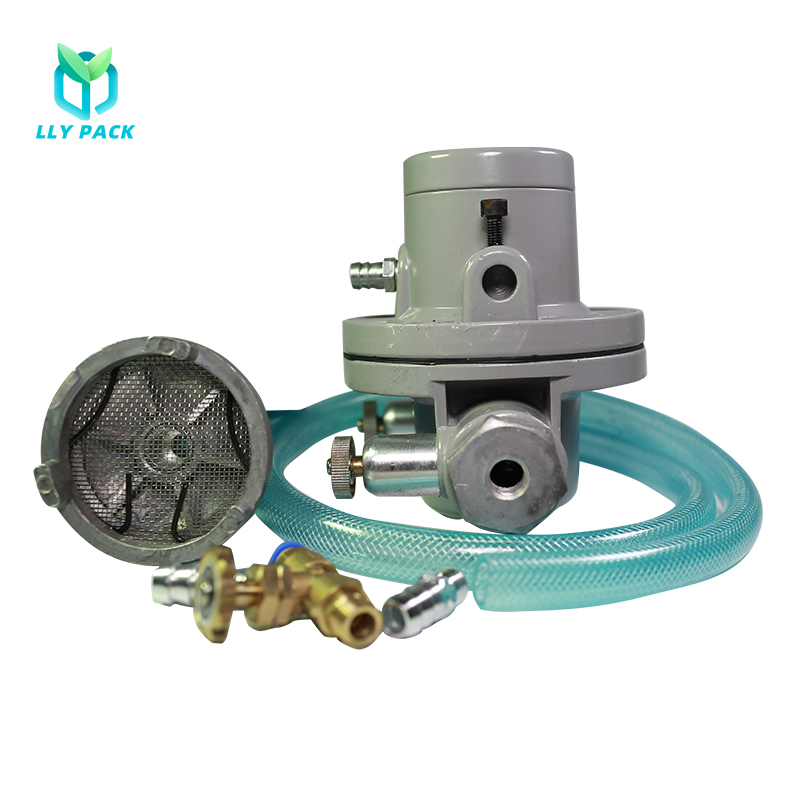
Diaphragm Pump DP-1: the supply side of a print fault is checked before the metering side.
Cutting and Creasing Symptoms: Blade, Die Board or Anvil Cover
Cutting symptoms localise well because every cut has a physical author. A continuous trim line belongs to the slitting blade, a slot to the slotting blade, a shaped cut to the rotary die board acting against the anvil cover, and a cross-cut to the NC cut-off blade. Naming the author is most of the diagnosis.
For trim problems, the Slitting Blade SLB-1 is a tungsten-steel component for carton manufacturing machinery with specifications customised according to customer drawings. SLB-1 is a drawing-based part: blade geometry, mounting features and edge configuration follow the customer drawing, which is why the drawing - not a photograph - is the ordering document.
Blade material descriptions are easy to misread. A published technical summary of corrugated slitting blades describes tungsten carbide as a common wear-resistant material and lists SKD11 and 9CrSi as alternatives, while LLY PACK specifies SLB-1 as tungsten steel, a different designation from tungsten carbide. Neither term should be treated as interchangeable with the other without confirming the grade with the supplier, and hardness figures are not part of the supplied specification.
For slotting, the Slotting Blade SB-1 is a tungsten-steel component for corrugated machine parts in the carton manufacturing industry, with parameters customised on the basis of customer drawings; the crease line is formed by the Creaser Wheel CWH-1, supplied by model designation. A tear that follows slot depth rather than slot length usually indicates a seating or depth problem before it indicates a blade problem, while whiskers at the slot end are the classic dull-edge signature.
For die-cutting, the Rotary Die Board RDB-1 is constructed from wood, foam and steel and its specifications can be customised as required; it cuts against the Anvil Cover Rubber ACR-1, supplied by model designation. Anvil condition typically shows as a cut that is clean in one lane and notched in another, or a repeat mark at a fixed interval. The supplied data for ACR-1 does not include hardness, thickness or tolerance values, so an anvil cover order must carry those figures from the drawing or the machine documentation. For cross-cutting, the NC Cut-off Blade NCOB-1 is a tungsten-steel blade with customised specifications; length variation and a non-square edge are register or knife-timing questions first and blade condition second.
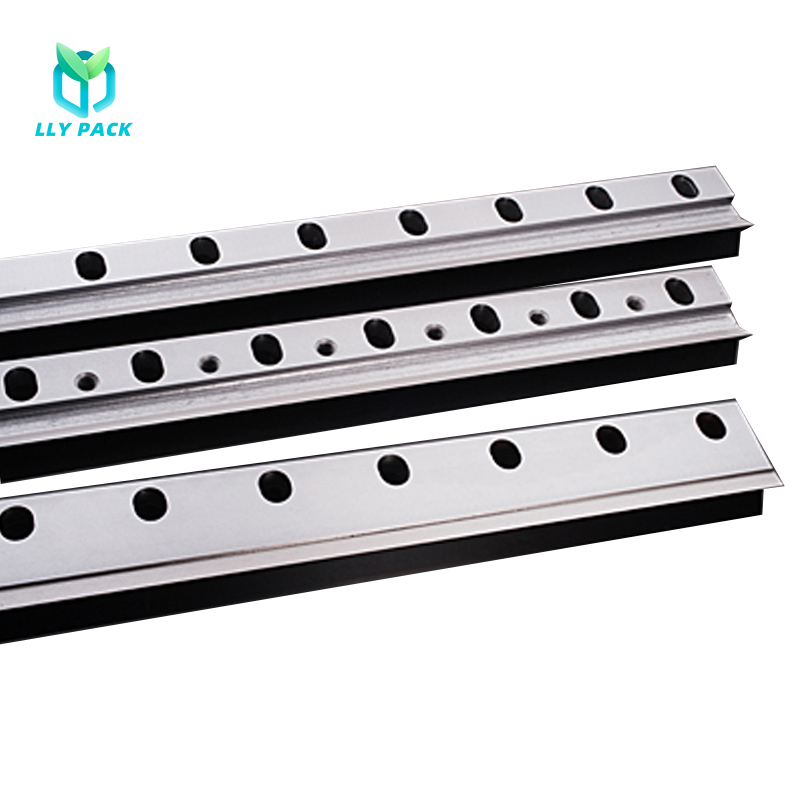
NC Cut-off Blade NCOB-1: cross-cut problems are checked against register and knife timing before blade replacement.
Tension, Braking and Pneumatic Symptoms
Web-handling symptoms are where part capacity and part wear are most often confused. The Pneumatic Brake PB-1 is made of plastic and steel, with a maximum torque of 2,800 Nm, maximum heat dissipation of 12 kW, thermal power of 3 kW at 100 rpm and a torque range of 0 to 400 Danm. Those are published performance parameters describing the brake's capacity envelope, not the condition of a brake already on a machine. Pad thickness, disc condition and the actual torque setting have to be measured on site.
Wear parts in that system are ordered by drawing. The Brake Pads BPA-1 are an iron component customised as drawings. Tension drift that worsens as reel diameter falls, or judder under braking, sends the check to pads, brake setting and reel seating. The Paper Chuck PCH-1, a steel component used in carton manufacturing, holds the reel; a reel that is not seated squarely can present as a tension fault that no brake adjustment will fully remove.
Pneumatic actuation fails in a recognisable way: slow response, incomplete stroke, or failure to hold position. The Pneumatic Cylinder PC-1 is a steel cylinder with bore sizes from 32 to 400 mm, a maximum stroke of 1,000 mm, working pressure of 1.5 to 8 bar, proof pressure of 12 bar, port sizes PT1/2, PT3/4, P1 and P1/4, and a working temperature range of -25 to 80 degrees Celsius, not for use under freeze conditions. Comparing the line's actual supply pressure and port size with those values is a short check that prevents ordering a cylinder for a pressure problem.
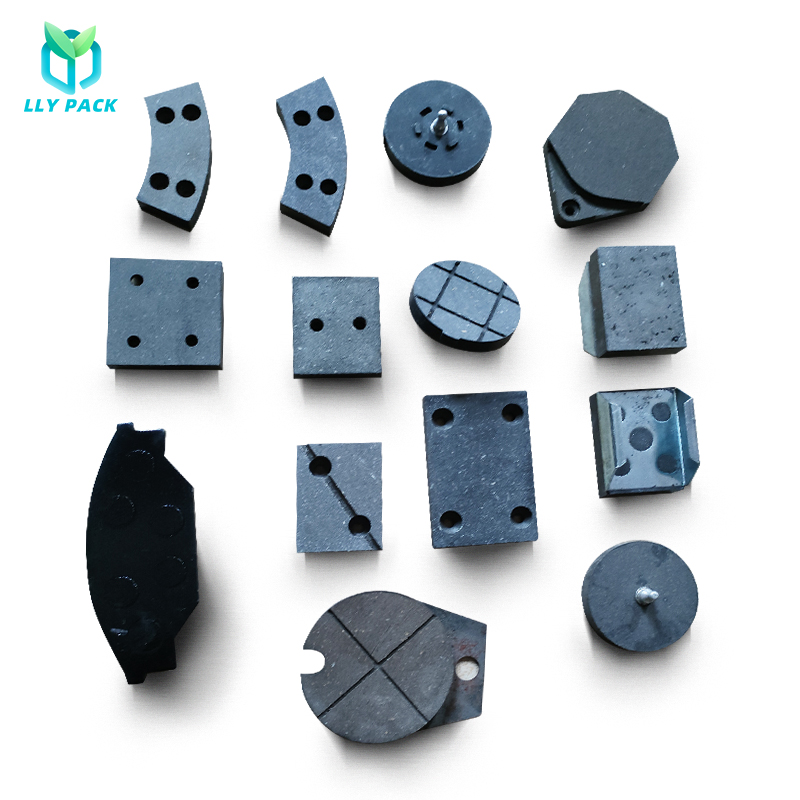
Brake Pads BPA-1: an iron wear part ordered from a drawing, not from a description.
Heat, Hose and Belt Symptoms
Hot-section faults announce themselves as leaks, condensate and splice failures. The Rotary Joint RJ-1 is a steel joint with customised parameters, designed for corrugated board production lines in carton manufacturing, and the Flexible Metal Hose FMH-1 is a steel hose with customised parameters. Because both are parameter-customised, the order has to carry connection size, length and working conditions rather than a model number alone.
Splice failures at the hot end are a tape specification question. The High Temperature Tape HTT-1 is made of cotton paper for industrial splicing in high-temperature environments in carton manufacturing, supplied in widths of 3 cm, 3.5 cm, 4 cm and 5 cm with lengths of 40 m or 50 m. The Fiber Tape FT-1 is made of fiberglass filament in 2.5 cm x 50 m and 4.8 cm x 50 m sizes for carton printing.
Belt symptoms - tracking wander, edge fraying, surface marking - belong to the belt and its alignment. The Conveyor Belt CB-1 is a polyurethane rubber timing belt for the corrugated carton packaging industry with an open-belt width tolerance of plus or minus 0.5 mm, and the Double Facer Belt DFB-1 is the belt component for the double facer section. Tension and pulley alignment should be verified before a belt is condemned.
Step-by-Step: Isolate the Category, Then Order
- Record the symptom in production terms. Note the station, the side of the web, the pattern and its spacing, the speed at which it appears, the paper grade and the reel. A photograph with a scale reference is worth more than a paragraph of description.
- Separate adjustment from wear. Check the station's settings against the machine manual, swap in a known-good consumable where one exists, and re-run. If the symptom follows the setting, the part is not yet the answer.
- Localise to one station. Isolate the affected station where the machine allows it, or compare the same job on a sister machine. Ambiguity at this step is what produces wrong-category orders.
- Name the category and confirm the installed model. Use the symptom-to-part table, then read the model marking on the installed component rather than trusting a spare-parts list alone.
- Capture the drawing data. Record dimensions with tolerances, the mounting or clamping interface, the material requirement and any mating part. For drawing-based items - SLB-1, SB-1, NCOB-1, BPA-1, PR-1, RJ-1 and RDB-1 - this is the actual order document.
- Cross-check the supplier's published specification. Confirm material and model, and flag any figure the supplier does not publish, such as anvil cover hardness or anilox cell volume, as something to measure or confirm rather than assume.
- Set quantity against criticality. One replacement plus one spare for a part that stops the line, one replacement for a long-life item. Stocking decisions follow line criticality, not discount size.
- Verify on receipt and on first run. Check dimensions against the drawing, confirm fit on the machine, then observe the symptom over a defined production period and record the result.
What the RFQ Should Contain
- Machine make, model and station, plus the model marking on the installed part.
- A dimensioned drawing with tolerances, including the mating interface.
- Material and any treatment requirement; state clearly if the grade must match an existing part.
- Quantity, and whether the order is a replacement or a first spare.
- Symptom description with a photograph and the production conditions where it appears.
- Required documentation: packing list, inspection record, or drawing revision reference.
Application Scenarios Where This Mapping Pays Back
The mapping fits any plant matching parts to a corrugated cardboard line rather than buying generically: the working conditions are high precision, high continuity and high speed; the function is converting raw paper into corrugated cardboard that meets specification; base paper adaptability and speed synchronisation are the standing special requirements; and operation may be semi-automatic or fully automatic.
This part-matching scenario is common in markets including Mexico, Brazil, India and Thailand, and appears more widely across South America, Southeast Asia, Africa, the Middle East and the domestic Chinese market - the regions where LLY PACK reports its export activity, with machines exported to more than 40 countries and export business accounting for 100% of sales.
As a conditional example rather than a reported case: a plant running two shifts notices print density falling on the drive side while slot quality stays stable. Following the sequence above, the ink supply is verified first and metering second; if the flow reading sits inside the DP-1 range of 4 to 12 L/min and the plate is unchanged, the anilox roller and printing roller become the drawing-based items to quote. The value of the example is not the outcome, which depends on the actual measurement, but the order of checks: supply, then metering, then part.
Part Comparison: Materials, Models and Customisation Routes
| Part category | Model | Material or construction | Published specification | Customisation route |
|---|---|---|---|---|
| Printing Anilox Roller | PAR-1 | Steel | Material and intended industry only | Customised for corrugated packaging machinery |
| Printing Roller | PR-1 | Steel | Parameters customised | Per supplied drawings |
| Printing Cushion | PCU-1 | Polyurethane foam | Cushioning component for printing equipment | As required |
| Slitting Blade | SLB-1 | Tungsten steel | Component for carton manufacturing machinery | Per customer drawings |
| Slotting Blade | SB-1 | Tungsten steel | Component for carton manufacturing | Per customer drawings |
| NC Cut-off Blade | NCOB-1 | Tungsten steel | Customised specifications | Per customer drawings |
| Rotary Die Board | RDB-1 | Wood, foam, steel | Used in carton printing applications | As required |
| Anvil Cover Rubber | ACR-1 | Not stated in supplied data | Model designation only | Confirm from drawing |
| Creaser Wheel | CWH-1 | Not stated in supplied data | Model designation only | Confirm from drawing |
| Brake Pads | BPA-1 | Iron | Intended for carton manufacturing | Customised as drawings |
| Pneumatic Brake | PB-1 | Plastic and steel | Max torque 2,800 Nm; max heat dissipation 12 kW; 3 kW thermal power at 100 rpm; torque range 0 to 400 Danm | Standard model |
| Pneumatic Cylinder | PC-1 | Steel | Bore 32 to 400 mm; stroke to 1,000 mm; working pressure 1.5 to 8 bar; proof pressure 12 bar | Standard model |
| Diaphragm Pump | DP-1 | Steel | Flow 4 to 12 L/min; working air pressure 0.2 to 0.5 MPa; lift 4 m | Standard model |
| No Crush Wheel | NCW-1 | Polyurethane | Five sizes from 100x45x50 mm to 180x65x50 mm | Size selection |
| Rotary Joint | RJ-1 | Steel | Parameters customised | Customised |
Where a cell states that a value is not in the supplied data, the figure must not be filled in by inference.
Frequently Asked Questions
How do I tell whether a print problem comes from the anilox roller or the ink supply?
Check the supply side first, because it can be tested without removing the roller. If the Ink Pump IP-1 or the Diaphragm Pump DP-1 is not delivering steadily - the DP-1 is published with a 4 to 12 L/min flow range at 0.2 to 0.5 MPa working air pressure - the symptom can look exactly like a metering problem. If ink reaches the print unit steadily but transfer is uneven across the web while plate and board are unchanged, the metering side is next: the Printing Anilox Roller PAR-1 and the Printing Roller PR-1. PAR-1 is supplied as a steel component customised for corrugated packaging machinery; cell volume and line screen are not in the supplied specification, so they must come from machine documentation or a measured print trial.
Which parts should I check first when the slotter tears the board?
Confirm slot depth and blade seating before ordering. If the tear follows one slot position and the edge shows whiskers, inspect the Slotting Blade SB-1, a tungsten-steel component customised according to customer drawings, together with the crease line formed by the Creaser Wheel CWH-1. If the tear appears where the die cuts, inspect the anvil surface and the Rotary Die Board RDB-1, which is built from wood, foam and steel and can be customised as required. A tear that follows the sheet rather than the tool points to board condition or tension instead.
Can slitting blades and brake pads be made to my drawings?
Yes, for both models. The Slitting Blade SLB-1 is a tungsten-steel component for carton manufacturing machinery with specifications customised according to customer drawings, and the Brake Pads BPA-1 are an iron component customised as drawings. The same drawing-based route applies to the Slotting Blade SB-1, the NC Cut-off Blade NCOB-1, the Printing Roller PR-1, the Rotary Joint RJ-1 and the Rotary Die Board RDB-1, whose specifications can be customised as required. Send a dimensioned drawing with tolerances and the mating interface, not only a photograph.
What should I measure before ordering an anvil cover or rotary die board?
Measure what the part has to fit, not only what the old part looks like: overall dimensions, mounting or clamping interface, and the machine station and model. For the Anvil Cover Rubber ACR-1 and the Rotary Die Board RDB-1, the supplied product data covers the model designation and the customisation route but not hardness, thickness or tolerance values, so those figures have to be confirmed with the supplier against your drawing or the machine documentation.
What is the fastest route to a quotation for a symptom I cannot fully identify?
Send the symptom, the station, the installed part model, the machine model, a photograph of the failed area and a dimensioned drawing where one exists, together with the quantity you want to hold as a spare. A supplier can only quote a category reliably when the drawing or the installed model identifies the interface, so this information shortens the exchange more than a price request alone. Part enquiries for these categories can be sent to LLY PACK by email at christina@lycorrugated.com.
Conclusion
Symptom-led ordering is slower for one shift and faster for every shift after it. The line tells you where the fault sits before it tells you which part to buy: pale or striped print points to the ink supply and metering chain, a ragged trim edge to the slitting blade, whiskers at a slot to the slotting blade, an uneven die-cut to the anvil cover and die board, a non-square cross-cut to the cut-off blade, tension drift to brake pads and reel seating, and a hot-section leak to the rotary joint and hose. Separating adjustment from wear before naming a category is what keeps a parts budget from becoming a diagnostic experiment, and a dimensioned drawing is what keeps the replacement from becoming a second experiment.
Next Step: Put the Symptom in Writing
Share the station, the symptom pattern, the installed model and a dimensioned drawing, and the enquiry can be matched to the correct part category instead of the nearest catalogue name. The full company and product reference is available in the LLY PACK brochure, and part questions can be sent to christina@lycorrugated.com.
Manufacturing background for drawing-based corrugated machine parts, produced with 4 sets of CNC machining centres from Japan.
Have Questions or Need More Details?
Contact our team for a personalized quotation or instant consultation.
Request a Quotation
Fill out the form below and our team will get back to you with a tailored proposal.
WhatsApp Direct Chat
Prefer to chat in real-time? Message us on WhatsApp for instant assistance & quick answers.
- Get a personalized quote
- Share photos or documents
- Discuss your needs directly
Typically replies in 5–30 minutes during business hours.