
Corrugated Cardboard Pre-Feeder vs. Manual Sheet Feeding: A Comparison Guide for Box Makers
Sheet feeding is the moment in a corrugated box plant where printed, slotted or plain board moves from a stack onto the infeed of a converting machine. It is also the moment where a lot of installed capacity quietly disappears, because the choice between an automatic corrugated cardboard pre-feeder and manual sheet feeding is usually made by habit rather than by numbers.
The short answer: an automatic pre-feeder is the better choice when required sheet throughput, stack weight, sheet format or shift length exceeds what operators can sustain with consistent quality. Manual feeding stays viable when runs are short, formats are small and labor is stable and available. The LLY PACK Pre feeder (PF-1) is rated for a maximum paper feed speed of 280 sheets/min, a maximum feeding weight of 1600–1800 kg, and sheet sizes from 300 × 600 mm up to 1600 × 3000 mm — those figures define the envelope in which the comparison should be made.
Quick answer at a glance
- Automatic pre-feeder (LLY PACK Pre feeder, PF-1): max paper feed speed 280 sheets/min, max feeding weight 1600–1800 kg, sheet range 300 × 600 mm to 1600 × 3000 mm, max stacking height 1800 mm, fork length 1600–1800 mm, power 13.7 HP, machine size 12267 × 4615 × 2395 mm.
- Manual sheet feeding: no rated sheet-per-minute ceiling; output depends on operator count, sheet weight, format and shift duration.
- Decision rule: automate when required average sheet rate, stack mass or shift consistency exceeds manual handling; stay manual for short runs, small formats and stable labor.
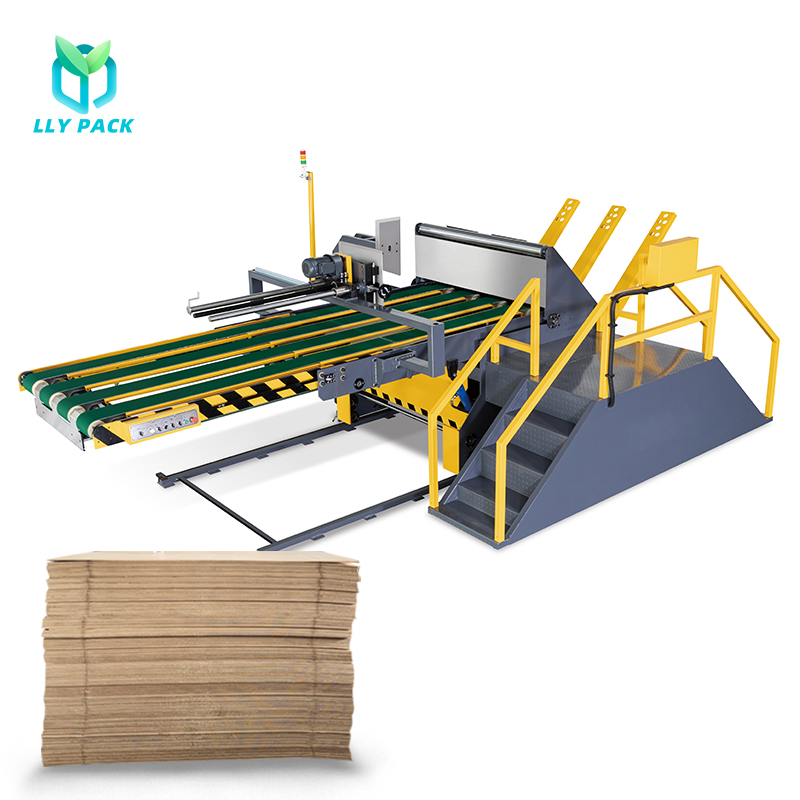
Problem Definition: What the Feeding Step Has to Deliver
Feeding is not a single task. It is four tasks performed at once, and each one fails in a different way.
- Rate. Present board to the converting machine at a sheet-per-minute pace that keeps the downstream equipment loaded rather than waiting.
- Alignment. Deliver each sheet square and repeatable, so print register and slotting position do not drift.
- Mass. Move the physical weight of a full stack without damaging the board edges or the flutes.
- Durability. Maintain all three of the above for an entire shift, not for the first two hours.
Manual feeding can satisfy all four requirements in some plants. The question is where the limits sit, and whether those limits fall inside or outside your production profile.
The mass limit
A pre-feeder such as the PF-1 is specified to handle stacks with a maximum feeding weight of 1600–1800 kg and a maximum stacking height of 1800 mm, using forks 1600–1800 mm long. Those are machine specifications, but they also describe the mass that would otherwise be separated, lifted and squared by hand. Manual feeding does not remove that work — it transfers it to people, and the amount transferred grows with board grade and format size.
The pace limit
Downstream equipment sets the pace that feeding must match. The LLY PACK Flexo printer (FP-1) has a maximum equipment speed of 350 sheets/min, while the Pre feeder (PF-1) is rated at a maximum paper feed speed of 280 sheets/min. The useful question is not which number is larger, but what average sheet rate your plant genuinely needs across a shift — and whether that average is only met in the first hour of a manual shift.
The consistency limit
Manual feeding has no fixed output figure because it depends on human variables: how many operators are scheduled, how heavy the sheets are, how far the stack is from the infeed, and how many hours have already been worked. Automatic feeding has a specified ceiling, which makes capacity planning possible in the first place. That predictability, more than peak speed, is what most box makers are actually buying.
Industry Background: Why Feeding Automation Is Being Priced Differently Now
The corrugated machinery market is expanding, and automation is taking a larger share of it. Grand View Research valued the global corrugated box making machine market at USD 2.21 billion in 2024 and projected it to reach USD 3.36 billion by 2033, growing at a CAGR of 4.8% from 2025 to 2033. Future Market Insights projects the corrugated box machine industry in China to rise at a 3.9% CAGR between 2026 and 2036, reflecting China's role as a global manufacturing hub.
Automation level is where the shift is clearest: Future Market Insights reports that automatic corrugated machines hold a dominant 55.6% share of global demand by automation level as of 2026. Feeding equipment sits inside that shift, because it is often the last manual station left on an otherwise automated line.
Quality requirements reinforce the same direction. The FEFCO GMP standard and ISO 3037:2022 are the primary global references for ensuring quality and edgewise crush resistance in corrugated cardboard production, and safety compliance for corrugated printing and converting machinery in the EU requires CE marking and adherence to standards such as EN ISO 12048 for compression testing. Consistent feeding protects the board from edge damage and misalignment that later show up as quality variation, not as a feeding problem.
Labor availability completes the picture. When skilled operators are scarce or expensive, a feeding station that requires one or two people per shift is not only a productivity question — it becomes a scheduling risk on every busy week of the year.
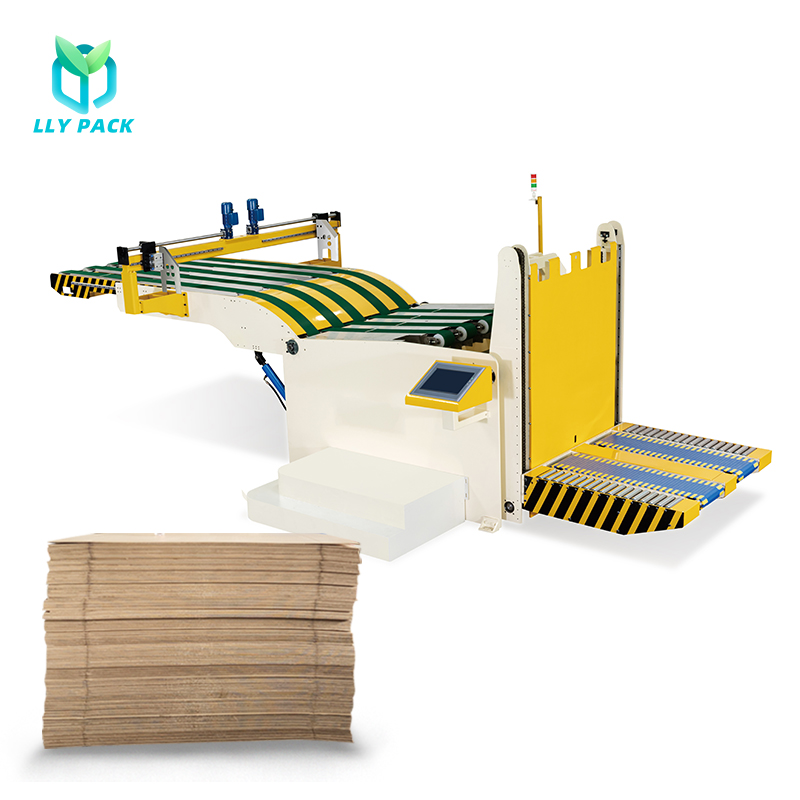
The Automatic Option in Detail: LLY PACK Pre feeder (PF-1)
LLY PACK (HK) CO., LIMITED is a corrugated machine manufacturer whose manufacturing facility is located in Foshan City, Guangdong Province, China, and which supplies corrugated cardboard production lines, single facers, auto splicers, corrugating rolls and corrugated belts to box plants worldwide. The Pre feeder PF-1 is the company's automatic sheet-feeding unit for the corrugated box packaging industry.
Its published specification is the practical starting point for any pre-feeder-versus-manual comparison:
- Machine type: Automatic Pre-Feeder Corrugated Sheets Feeding Machine
- Model: PF-1
- Max paper feed speed: 280 sheet/min
- Max feeding weight: 1600 kg – 1800 kg
- Max sheet size: 1600 × 3000 mm
- Min sheet size: 300 × 600 mm
- Max stacking height: 1800 mm
- Fork length: 1600–1800 mm
- Power: 13.7 HP
- Dimensions (L × W × H): 12267 × 4615 × 2395 mm
- Material: steel
- Applicable industry: corrugated box packaging industry
Reading the specification as a buyer
The sheet-size range matters more than the headline speed in most plants. A pre-feeder that covers 300 × 600 mm to 1600 × 3000 mm can serve both small carton work and large format board on the same line, which is what allows a single feeding investment to replace manual handling across a mixed product mix rather than only on the heaviest jobs.
The 1600–1800 kg feeding weight and 1800 mm stacking height determine how much board can be staged in one load. Higher stacks mean fewer loading interruptions; the fork length of 1600–1800 mm determines compatibility with the pallets and stack bases already in your plant, and should be checked against existing logistics before ordering.
Power, footprint and line integration
At 13.7 HP, the PF-1 draws far less power than the corrugating and converting equipment it supports, so energy is rarely the deciding cost. Footprint is the harder constraint: at 12267 × 4615 × 2395 mm, the unit needs clear floor space in front of the machine it feeds, and access for stack delivery.
Integration matters on both sides of the unit. Upstream, the LLY PACK Corrugated Cardboard Production Line (CCPL-1) runs at a maximum mechanical speed of 300 m/min with a line width of 1400–2800 mm; downstream, converting equipment such as the Flexo printer (FP-1) reaches a maximum equipment speed of 350 sheets/min and the Slitter scorer (SSC-1) runs at 630–900 m/min. Feeding capacity should be planned against your real average rate across that chain, not against the fastest machine in it.
Certification and documentation
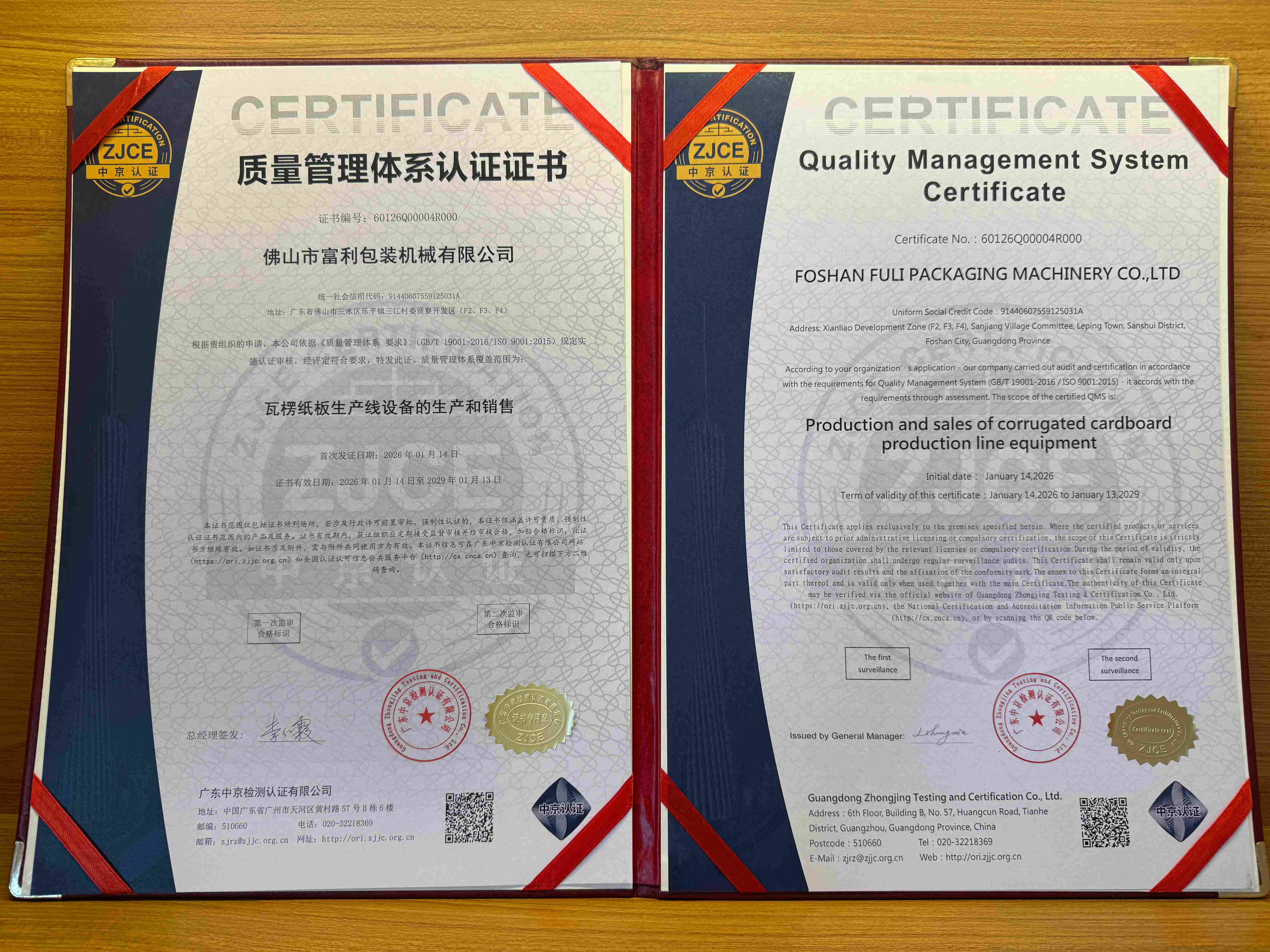
For buyers who must file compliance evidence, the relevant record is the ISO 9001:2015 certification held for the Corrugated Cardboard Production Line (CCPL-1). The certificate number is 60126Q00004R000, issued by Guangdong Zhongjing Testing and Certification Co., Ltd. against the standard GB/T 19001-2016/ISO 9001:2015. It applies to the global market and remains valid until January 13, 2029. The Pre feeder (PF-1) is listed among the related products of that certified production line scope.
At company level, LLY PACK holds more than 100 patent rights and certificates from the industry, and its factory is equipped with 4 sets of advanced CNC centers from Japan used to maintain high-precision processing.
Step-by-Step Breakdown: How to Run the Comparison in Your Own Plant
Step 1 — Establish the required average sheet rate
Start from the converting machine, not from the feeder. Record the highest sustained sheet rate your plant actually needs over a full shift, then compare it with the PF-1 ceiling of 280 sheets/min. If your required average sits well below that figure, feeding speed alone will not justify automation — consistency and labor might.
Step 2 — Map your sheet format range
List the sheet sizes produced in a normal month. If the range falls inside 300 × 600 mm to 1600 × 3000 mm, a single pre-feeder can cover the mix. Formats beyond either end of that envelope need separate planning rather than an assumption.
Step 3 — Weigh the stack, not the sheet
Manual handling limits are reached at stack level, not sheet level. Compare your typical pallet or stack load against the 1600–1800 kg feeding weight specification. Where manual handling is currently split into several smaller stacks to remain feasible, count the labor and time that splitting costs per shift.
Step 4 — Audit labor availability and shift pattern
Count the operators assigned to feeding per shift, including relief cover for breaks, absence and peak weeks. Manual feeding cost scales with headcount and shift length; automatic feeding cost is largely fixed after installation, which makes the comparison sensitive to how many shifts per week you run.
Step 5 — Verify compliance evidence before ordering
Request the certification documentation relevant to the equipment scope, confirm the certificate number, issuing authority and validity date, and check which products are covered. For LLY PACK's production line scope, that is certificate 60126Q00004R000 under GB/T 19001-2016/ISO 9001:2015, valid until January 13, 2029.
Step 6 — Confirm footprint, power and logistics
Check the 12267 × 4615 × 2395 mm machine footprint against available floor space, the 1600–1800 mm fork length against your existing stack bases, and the 13.7 HP power requirement against installed capacity. These are the checks that most often change a project timeline after the commercial decision has already been made.
Step 7 — Define what “consistent” will be measured against
Decide in advance which quality indicators will be tracked before and after the change. Compression and crush performance checks can be made with a carton testing instrument such as the LLY PACK CTI-1, which measures burst strength from 250 to 5600 kPa and crush performance from 60 to 3000 N, with accuracy of ±0.5%FS / 0.005 mm. Setting the measurement method early prevents the comparison from ending in a purely subjective verdict.
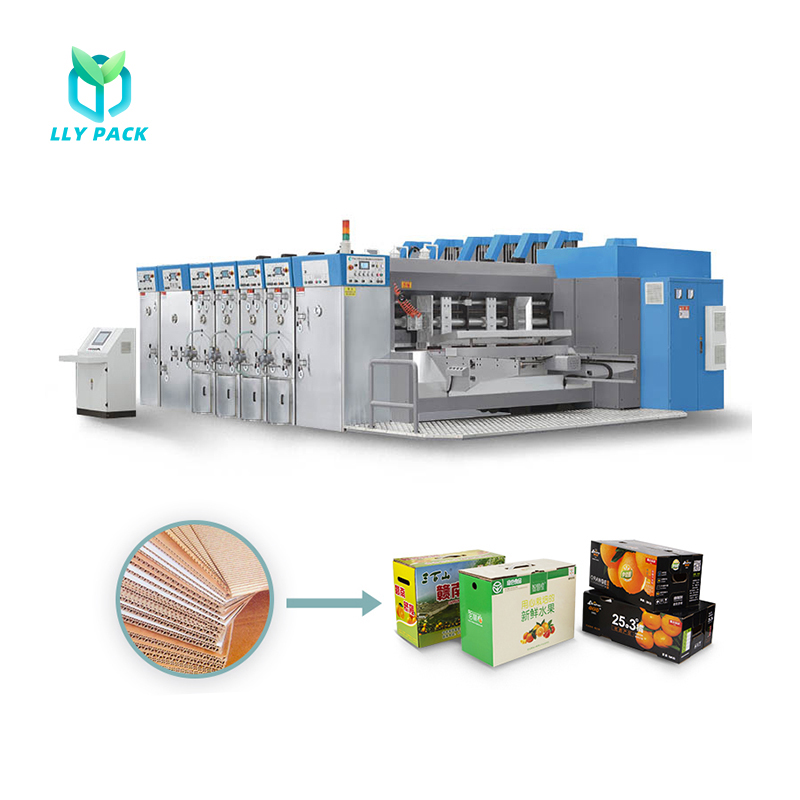
Use Cases: Where Each Feeding Method Fits
Case 1 — High-volume plant feeding a flexo printer slotter
A plant running large-format work into a machine with a maximum equipment speed like the FP-1's 350 sheets/min needs feeding that holds pace across extended runs. Where the manual alternative requires several operators per shift and repeated stack splitting, a PF-1 rated at 280 sheets/min and 1600–1800 kg per load gives a defined, plannable feeding rate for the full shift.
Case 2 — Mixed-format job shop with frequent changeovers
Short runs and small formats are the classic argument for staying manual. The counter-argument appears when the same plant also handles large sheets: a machine covering 300 × 600 mm to 1600 × 3000 mm can be used selectively on the heavy jobs while manual handling continues on light work, avoiding a single all-or-nothing decision.
Case 3 — Lines built from scratch
Plants constructing a new corrugated carton plant have the chance to place feeding in the original layout rather than retrofitting it. LLY PACK has supplied a corrugated paper carton manufacturer with 9 units over a 10-year working relationship, successfully building a complete corrugated carton production line from scratch with fully automatic production. That experience is relevant to feeding decisions because on a new line, the feeding station, conveyor layout and stack logistics are designed together instead of negotiated around existing equipment.
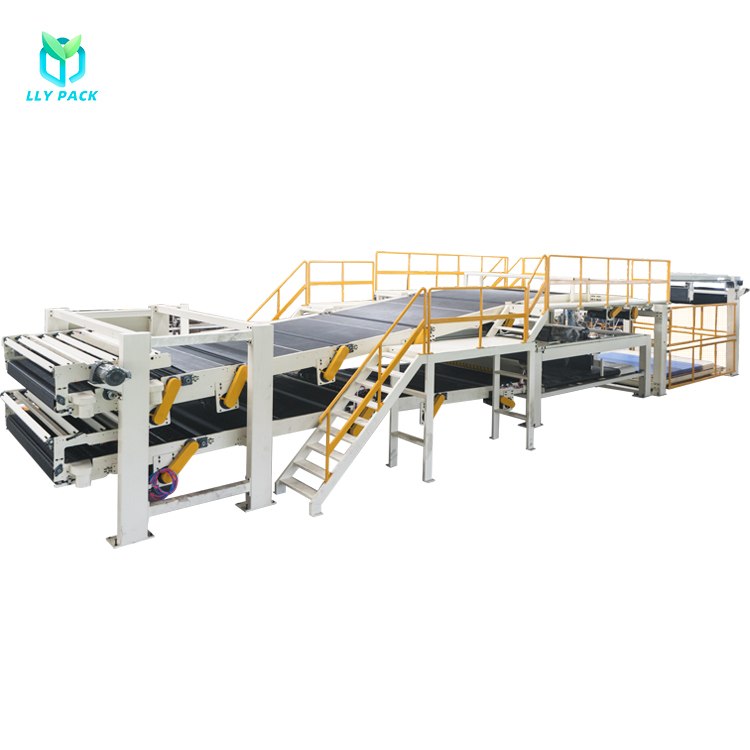
Comparison Table: Automatic Pre-Feeder vs. Manual Sheet Feeding
| Decision factor | Automatic pre-feeder (LLY PACK PF-1) | Manual sheet feeding |
|---|---|---|
| Rated feeding capacity | Max paper feed speed 280 sheet/min | No rated sheet-per-minute figure; output depends on operators, sheet weight and format |
| Sheet size coverage | 300 × 600 mm minimum to 1600 × 3000 mm maximum | Practically limited by what operators can lift and square; large formats require more people |
| Stack weight handling | Max feeding weight 1600–1800 kg per load | Full loads of that weight are not manually liftable; stacks must be split |
| Stack height | Max stacking height 1800 mm | Stack height limited by operator reach, typically built lower |
| Stack interface | Fork length 1600–1800 mm | No fork interface; sheets moved by hand or with a pallet truck |
| Installed power | 13.7 HP | No machine power draw; energy supplied by operators |
| Floor space | Machine footprint 12267 × 4615 × 2395 mm plus access for stack delivery | No machine footprint, but staging and stacking space still required |
| Throughput consistency across a shift | Fixed rated ceiling independent of shift hour | Varies with fatigue, crew size and shift length |
| Manual handling exposure | Reduced repetitive lifting; stack transferred mechanically | Continuous repetitive lifting and squaring of board stacks |
| Documentation trail | Covered by the supplier's ISO 9001:2015 production line scope, certificate no. 60126Q00004R000, valid until January 13, 2029 | No equipment certification applies |
| Best suited to | Sustained sheet demand, heavy formats, multi-shift operation, tight labor supply | Short runs, small formats, low volumes, stable and available labor |
FAQ
1. What certification documentation is available for the feeding equipment and the production line it belongs to?
The Corrugated Cardboard Production Line (CCPL-1) holds ISO 9001:2015 certification under the standard GB/T 19001-2016/ISO 9001:2015. The certificate number is 60126Q00004R000, it was issued by Guangdong Zhongjing Testing and Certification Co., Ltd., it applies to the global market, and it is valid until January 13, 2029. The Pre feeder (PF-1) is listed among the related products within that certified production line scope. Buyers who need documentation for internal quality files should request the certificate together with the equipment quotation, because the applicable scope and product coverage need to be verified against the exact configuration being ordered.
2. What sheet sizes and stack weights can the LLY PACK Pre feeder (PF-1) handle?
The PF-1 handles corrugated sheets from a minimum of 300 × 600 mm to a maximum of 1600 × 3000 mm. Its maximum paper feed speed is 280 sheet/min, its maximum feeding weight is 1600–1800 kg, its maximum stacking height is 1800 mm, and its fork length is 1600–1800 mm. The unit runs on 13.7 HP, is built from steel, and is designed for the corrugated box packing industry. In practice, the sheet-size range determines product mix coverage, while the feeding weight and stacking height determine how long a single load can run before reloading.
3. What drives the cost and payback of switching from manual feeding to a pre-feeder?
Four factors dominate. First, labor: manual feeding cost scales with operators per shift and shifts per week, while an installed pre-feeder is largely a fixed cost. Second, throughput: if required sheet demand sits close to or above what operators can sustain, the feeding station caps the output of faster downstream equipment. Third, format: covering sheets from 300 × 600 mm to 1600 × 3000 mm allows one investment to serve a mixed product range rather than only heavy jobs. Fourth, installation conditions, including the 12267 × 4615 × 2395 mm footprint, the 1600–1800 mm fork length and the 13.7 HP power supply. Future Market Insights reports that automatic corrugated machines hold 55.6% of global demand by automation level as of 2026, which indicates how broadly the labor-versus-automation calculation has already shifted.
4. How should a buyer validate the feeding change before committing to a full line configuration?
Validation should use the plant's own board, not a demonstration format. Run production sheets across the intended size range and confirm that the feeding rate holds at the required average, that stack loading and fork handling match existing pallets and stack bases, and that downstream equipment receives sheets square and undamaged. Set the quality measurement before the trial: instruments such as the LLY PACK Carton testing instrument (CTI-1) measure burst strength from 250 to 5600 kPa and crush from 60 to 3000 N with accuracy of ±0.5%FS / 0.005 mm, which allows before-and-after comparison on the same batch of board.
5. How is scheduling and delivery handled for a feeding upgrade?
Timing depends on configuration, so it should be confirmed against the project schedule rather than assumed from a catalogue. LLY PACK's background is relevant here: more than 25 years specialising in corrugated machines and high-speed corrugated cardboard production lines, machines exported to over 40 countries, and more than 3,500 successful installations of corrugated lines worldwide. For plants building or expanding a line, the practical next step is to send the sheet size range, required average sheet rate per shift, and current manual headcount to the supplier so that a configuration and schedule can be quoted against real numbers.
Conclusion: A Simple Decision Framework
Three questions decide the comparison. Answer them in order, and the feeding decision stops being a matter of preference.
- Production volume. If the required average sheet rate per shift approaches the point where operators cannot keep the downstream machine loaded, automation wins. The PF-1 ceiling of 280 sheets/min gives a fixed reference against your own measured average.
- Labor availability. If feeding currently requires multiple operators per shift, with relief cover for breaks, absence and peak weeks, the manual option carries a recurring cost and a scheduling risk that does not appear on the machine quotation.
- Long-run consistency. If quality variation and output variation between the first and last hour of a shift are already visible in your data, a machine-rated feeding rate solves a problem that more operators cannot.
Where all three point the same way, an automatic pre-feeder is the lower-risk configuration. Where volumes are low, formats small and labor stable, manual feeding remains a legitimate choice — provided the plant accepts that the feeding station, not the converting machine, will set the ceiling.
Next step: compare the numbers against your own line
Share your sheet size range, required average sheets per minute and current feeding headcount, and LLY PACK can confirm whether the Pre feeder (PF-1) fits your configuration — including fork length, footprint and integration with your existing corrugated cardboard machine chain.
Download the full product brochure: LLY PACK brochure (PDF)
Website: www.llypack.com
Email: christina@lycorrugated.com | WhatsApp: +86 13763260555
Have Questions or Need More Details?
Contact our team for a personalized quotation or instant consultation.
Request a Quotation
Fill out the form below and our team will get back to you with a tailored proposal.
WhatsApp Direct Chat
Prefer to chat in real-time? Message us on WhatsApp for instant assistance & quick answers.
- Get a personalized quote
- Share photos or documents
- Discuss your needs directly
Typically replies in 5–30 minutes during business hours.