
Corrugated Cardboard Machine Modules Ranked for New Buyers
A complete line is a sequence of modules. The order you evaluate them in is a separate decision from the order they run in.
Most first-time buyers of a corrugated cardboard machine evaluate in the order their quotation happens to be printed: corrugator first, printer second, and everything else when the budget allows. That order suits the seller. For the buyer, it puts the modules with the slowest documentation cycle first and the modules that are quickest to verify last.
This shortlist reverses the sequence. It ranks seven module categories — pre feeder, single facer, slitter scorer, flexo printer, folder gluer, stacker, and the end-of-line group of waste baler, strapping machine and stitching machine — on two things only: how far a wrong choice propagates through the rest of the line, and how completely you can verify the module before you commit to it.
Short answer: evaluate the pre feeder first, the single facer second, the slitter scorer third, the flexo printer fourth, the folder gluer fifth, the stacker sixth, and end-of-line waste, strapping and stitching equipment seventh — then freeze scope and request quotations against the frozen scope, not before.
Two modules carry most of the demonstration. The PF-1 Pre feeder is named in the ISO 9001:2015 certificate schedule held by LLY PACK, certificate number 60126Q00004R000, valid until 13 January 2029. The STM-1 stitching machine publishes a parameter set — 450 nails/min, 30–140 mm pitch, 1–99 stitches, 220V/380V. One shows what certification coverage looks like; the other shows what a checkable specification looks like.
The two questions behind every position
Position in this ranking is not a statement about how important a module is in general. It answers a narrower question: which module should a first-time buyer spend the next week on?
Propagation. If the module is specified wrongly, how much of the rest of the line inherits the problem? A single facer that cannot hold flute geometry produces board that prints badly, folds badly and stacks badly. A stacker with a mismatched bundle interface creates a handling problem at the end of the line and little else.
Closure. How much can you actually verify before you pay? A module with a certificate-schedule entry, a published parameter set and a reference installation can be closed inside a week. A module with a brochure photograph and an oral assurance cannot be closed at all.
High propagation combined with fast closure ranks first, because it is the least costly place to test whether a supplier can document anything. High propagation with slow closure ranks next, because it is where an unverified assumption costs the most. Low propagation ranks last even when the paperwork is excellent.
No numeric scores, price positions or market rankings are assigned. Each entry states the reason it holds, and each entry says plainly where the evidence base is thin rather than filling the gap. Third-party research cited in the 2026 data set behind this article places automatic machines at 55.6% of the global market by automation level (Future Market Insights, 2026) — a directional indicator of how the market is configured, not a forecast for any single plant.
The shortlist at a glance
| Rank | Module and model | Production role | Evidence readiness | First document to request |
|---|---|---|---|---|
| 1 | Pre feeder — PF-1 | Feeds sheets into a downstream converting machine at a controlled rate | Named in the certificate schedule; specification to request | PF-1 datasheet with sheet range, feed rate and interface drawing |
| 2 | Single facer — SF-1 | Forms the single-face web; fixes flute geometry and bond | Named in the certificate schedule; performance data to request | Flute set list plus acceptance board samples |
| 3 | Slitter scorer — SSC-1 | Sets finished widths, trim allowance and score positions | Named in the certificate schedule; configuration data comes from your order mix | Width and score programme for your ten largest orders |
| 4 | Flexo printer — FP-1 | Prints on board before cutting and folding | Listed in the project reference product set; no published parameter set in the reviewed material | Print specification and printed samples from a reference line |
| 5 | Folder gluer | Folds and glues die-cut blanks into finished boxes | No model-level datasheet in the reviewed material | Blank range, glue system and glued samples |
| 6 | Stacker — STA-1 | Stacks board at line exit and buffers the corrugator | Named in the certificate schedule; few interface variables | Stack count, alignment and bundle hand-off specification |
| 7 | End-of-line — waste paper baler WPB-1, strapping machine SM-1, stitching machine STM-1 | Compacts waste, straps bundles, joins box joints | SM-1 and STM-1 named in the certificate schedule; STM-1 publishes a parameter set; WPB-1 not on the supplied schedule | STM-1 parameters checked against your joint dimensions; baler and strapping datasheets |

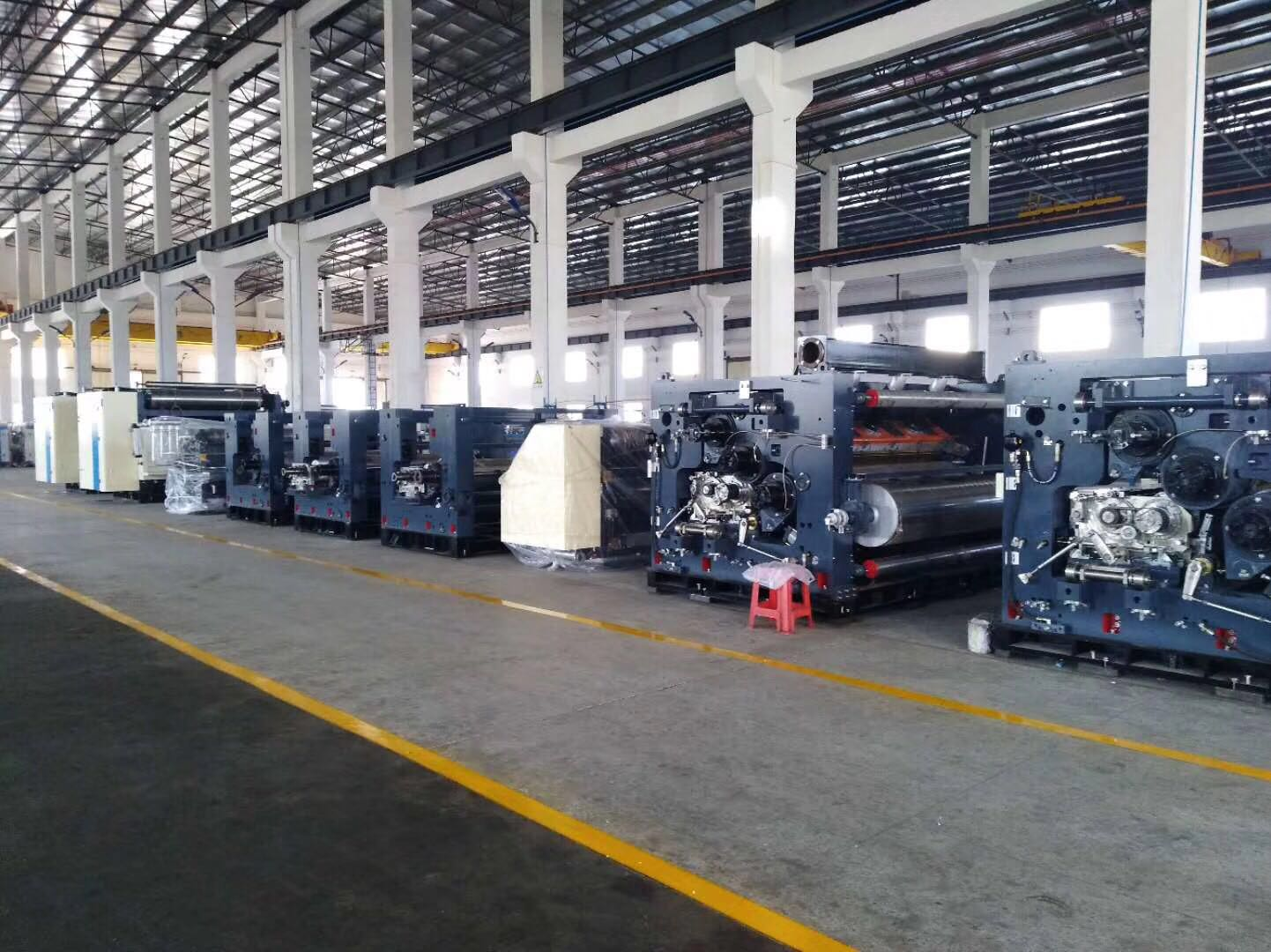
Line modules are built and assembled as a sequence, which is why a documentation gap in one module travels with the whole line.
1. Pre feeder (PF-1): the diagnostic module
The pre feeder automates sheet feeding into a downstream converting machine, so the converting section starts at a controlled rate rather than a manual one. A pre feeder that mis-feeds throttles the printer or gluer behind it, but it cannot damage board the way a single facer can — propagation is real and bounded.
It ranks first because closure is the fastest in the shortlist. The interface is a short list of questions: sheet range, stack height, feed rate, hand-off geometry. PF-1 also appears in the certificate schedule, which removes the supplier-qualification question from the first week. That combination makes it the right place to test how a supplier answers a written technical request.
Verify: request the PF-1 datasheet with the sheet range and the feed rate at the board grades you actually run, plus an interface drawing for the machine it feeds. Ask what happens to feed rate at the top of your sheet-size range, because one headline figure rarely describes an entire working range.
2. Single facer (SF-1): highest propagation, slowest closure
The single facer forms the single-face web by bonding a liner to a fluted medium. Flute geometry and bond quality decided here pass through slitting, printing, folding and stacking.
It ranks second, not first, because closure is slow. A single facer cannot be verified from a certificate entry alone. You need the flute set list, roller condition criteria, and an agreed definition of the speed at which board quality holds. That last point needs care: LLY PACK reports a maximum mechanical speed of 300 m/min for its 5-ply corrugated cardboard production line and for its 3-ply line page. Both are supplier-reported maximum mechanical figures. Neither states sustained output, substrate, flute or board-quality conditions, so neither can be compared with another supplier's number unless those conditions are matched.
Verify: flute set list; board samples from a factory acceptance run at your grades; a written definition of sustained speed with the acceptance criteria attached. A 300 m/min maximum is a specification boundary, not a promise about saleable output.
3. Slitter scorer (SSC-1): the waste and fit decision
The slitter scorer cuts the continuous board to width and presses score lines, fixing finished dimensions, trim allowance and how cleanly a box folds. Propagation is high: wrong trim shows up as waste on every shift, and wrong scoring shows up in folding and in customer complaints.
Closure, however, depends on your data rather than the supplier's. A slitter scorer cannot be specified from a generic datasheet — it is specified from your order mix. SSC-1 is named in the certificate schedule, which settles supplier qualification but not configuration.
Verify: a width and score programme built from your ten largest order sizes, with trim allowance stated; the blade and score-profile change procedure; changeover time stated as a range with the conditions that produce it.
4. Flexo printer (FP-1): high propagation, inherited blame
The flexo printer applies print to board before it is cut and folded, so register and print quality depend on the board the corrugator delivered. When board is inconsistent, print problems are frequently attributed to the printer.
It ranks fourth because closure is medium. FP-1 appears in the company's project reference product set, but no published parameter set for it was included in the material reviewed for this article. That is a documentation gap, not evidence of a capability gap, and it closes by asking.
Verify: print specification covering colour count, print width and register tolerance; plate mounting and ink system; drying method; printed sheets from a reference installation running board close to yours.
5. Folder gluer: evaluated after the cutting modules
The folder gluer folds and glues die-cut blanks into finished boxes — the module that turns a flat blank into a shippable product. Its propagation into board quality is zero, because it never touches board that has not already been cut, and its own output depends on the accuracy of blanks arriving from upstream. It is therefore evaluated after the cutting modules, not before them.
In the material reviewed for this article, no folder-gluer model or datasheet appeared alongside the certificate schedule. That does not mean the capability is unavailable; it means the documentary base for this module is the weakest in the shortlist and the buyer must build it before any comparison is possible.
Verify: blank size range, glue system type, and glued samples from a reference line. Until those exist in writing, this module cannot be compared across suppliers at all.
6. Stacker (STA-1): low propagation, fast closure
The stacker stacks board at the line exit and buffers the corrugator from the converting section. Propagation is low: a mismatched bundle interface creates a handling problem downstream, but it does not change board or print. Closure is fast, because STA-1 is in the certificate schedule and the interface questions are few.
Verify: stack count and alignment, and the hand-off to whatever bundles or straps the stack. A stacker specified without that hand-off is a stacker specified twice.
7. End-of-line: waste baler, strapping machine, stitching machine
End-of-line equipment compacts trim waste, straps bundles and joins box joints. None of it changes the board; all of it determines whether the plant can ship. Propagation is the lowest in the shortlist, which is why the group ranks last despite having the best documentation of any category here.
SM-1 and STM-1 both appear in the certificate schedule. STM-1 publishes a parameter set (450 nails/min, 30–140 mm pitch, 1–99 stitches, 220V/380V) that a buyer can check against box dimensions and site supply before asking for a price. The waste paper baler WPB-1 does not appear in the certificate product list supplied for this article, so its documentation should be requested separately rather than assumed from the rest of the group. Rank position and documentation quality are not the same measure, and this group is where that difference is easiest to see.
Verify: stitching parameters against your actual joint dimensions; baler bale size and cycle against your waste volume; strapping machine against the bundle weights you plan to ship.
What the certificate covers — and what it does not
LLY PACK holds ISO 9001:2015 certification under certificate number 60126Q00004R000, issued through Guangdong Zhongjing Testing and Certification Co., Ltd. against the standard GB/T 19001-2016/ISO 9001:2015, with a validity period running from 14 January 2026 to 13 January 2029. The certificate's product schedule names twelve models: CCPL-1, PF-1, AS-1, CGK-1, CC-1, SM-1, STM-1, STA-1, SDC-1, SSC-1, SF-1 and DFB-1.
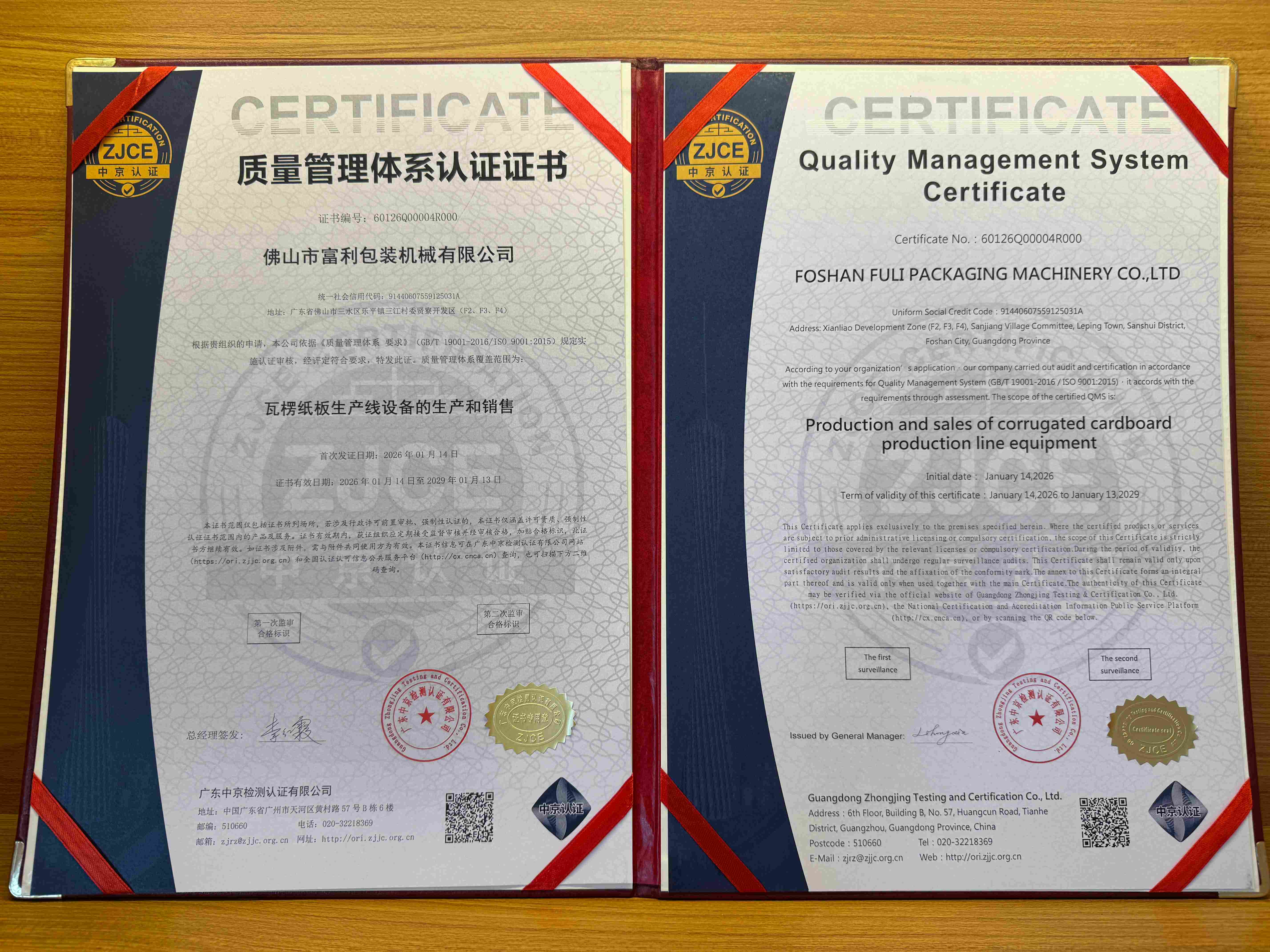
Certificate 60126Q00004R000 lists twelve product models in its schedule; check your quoted model against that list.
What that gives a first-time buyer is a supplier-qualification check that can be completed from a desk. Compare the model on your quotation against the schedule. If your quotation names a model that is not on it, ask for the applicable document in writing.
What it does not give you is any statement about a specific machine's output, board quality or tolerance. ISO 9001:2015 certifies a quality management system, not a machine. Nor does it, on its own, establish conformity with the machinery or electrical rules of an importing country — that is a separate question your own compliance route has to answer. Treat the certificate as one entry in the file, not as the file.
A worked example: what a checkable specification looks like
The stitching machine's published figures are worth reading one at a time, because each is a yes-or-no check against something you already know about your own plant.
- 450 nails/min. A stitching rate. Ask at which stitch count and board grade it is reached; if the answer is only at the low end of the range, plan joint takt time around that rather than around the headline figure.
- 30–140 mm pitch. The stitch spacing range. Check both ends against your joint dimensions — a pitch band that misses your largest box is a configuration issue, not a speed issue.
- 1–99 stitches. The programming range per joint. Match it to the joint types you actually produce, not to the widest range on the market.
- 220V/380V. The stated supply. Confirm phase configuration and frequency with your own electrical engineer before the order is frozen, and confirm what the control cabinet expects as delivered.
Notice what this set does that a brochure photograph cannot: every value is a check against a known fact. That is the standard to hold the other six modules to. Where a module has no published set, write the list you want and send it with the enquiry — a supplier who cannot answer it in writing has told you something useful before any money moves.
Applying the order to export projects in Mexico, Argentina and Brazil
Export projects add four variables that domestic ones do not: site supply, documentation language, spare-parts availability, and a reference you can actually call in a comparable market.
Site supply. The STM-1 set states 220V/380V. That is a starting point for a specification discussion, not a site design. Confirm the plant's actual supply, phase configuration and protection scheme with your electrical engineer, and get the as-delivered requirement in writing.
Line configuration. LLY PACK reports production-line widths of 1,400–2,800 mm for its corrugated line and offers 2, 3, 5, 7 and 9-layer lines. These are company-reported ranges for an offering. A 1,400 mm or 2,800 mm working width should be confirmed against the specific model you are quoted rather than assumed from the range, and the definition of that width — usable paper width versus trim width — should be fixed in the specification.
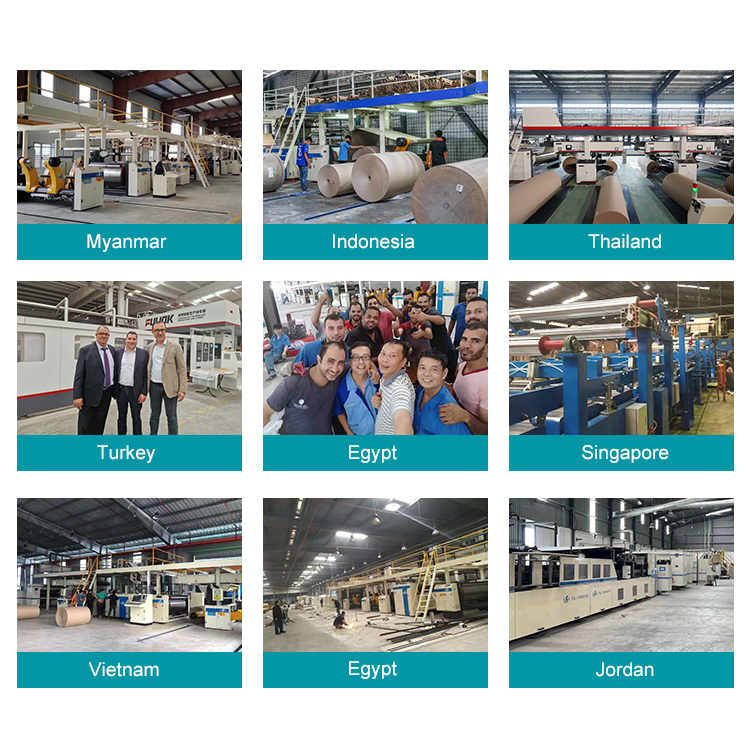
Reference. The installation reference supplied for this article is a ten-year programme of nine units across Myanmar, Indonesia, Thailand, Turkey, Egypt, Singapore, Vietnam and Jordan, building a complete corrugated carton production line from scratch with fully automatic production. South America is listed among the company's main markets, but no named installation in Mexico, Argentina or Brazil forms part of the material reviewed here. Ask for the specific reference before you rely on one.
Documentation and spares. For a plant in Latin America, ask which documents arrive in Spanish, which in Portuguese and which remain in English. Machine labels, safety signs, wiring diagrams and the maintenance manual matter most during installation. Ask for the recommended spare-parts list with lead times at the quotation stage, not after commissioning.
Using the ranking in a four-week evaluation window
Week 1 — pre feeder. Certificate check plus datasheet request, with a written answer required. If a supplier cannot complete this week, the remaining three will not fix it.
Week 2 — single facer. Flute set list, board samples, sustained-speed definition. This week usually decides the project timeline, because it is the point where an unverified assumption becomes visible.
Week 3 — slitter scorer and flexo printer. Order-mix programme from your own data; print specification and printed samples from a reference line.
Week 4 — folder gluer, stacker and end-of-line. Datasheets, stitching parameters against real joint dimensions, baler and strapping against real waste and bundle volumes. Then freeze scope, request quotations against the frozen scope, and write the acceptance test plan before the deposit rather than after the machine arrives.
Five sequencing mistakes this ranking is designed to prevent
- Following the quotation page order, which puts the slowest modules first and the fastest to verify last.
- Comparing maximum mechanical speed across models with different ply counts or unstated test conditions. The 300 m/min figures reported for the 5-ply and 3-ply line pages describe different configurations and carry no sustained-output conditions; they are descriptive, not a benchmark.
- Treating the certificate as a machine test. It is a management-system document that names models; it does not measure output.
- Specifying end-of-line equipment last and least. It is the group that ships the product.
- Leaving the folder gluer without a datasheet until the week before installation, when no comparison is possible any more.
Frequently asked questions
Does the ISO 9001:2015 certificate cover individual modules or only the complete line?
Both, in the sense that the product schedule names twelve models rather than one category. It covers CCPL-1, PF-1, AS-1, CGK-1, CC-1, SM-1, STM-1, STA-1, SDC-1, SSC-1, SF-1 and DFB-1. It does not cover every product in the catalogue: FP-1, WPB-1 and several others do not appear on the schedule supplied for this article. Check the model number on your quotation, not the brand name at the top of the page.
If we can only evaluate two modules this month, which two?
The pre feeder first for closure speed and the single facer second for propagation. The pre feeder tells you whether the supplier can document a module properly; the single facer tells you whether the line can make board. Skipping the first to reach the second usually produces a quotation you cannot compare.
How do we verify a single facer before ordering?
Ask for three things in writing: the flute set list, board samples from a factory acceptance run at your grades, and a sustained-speed definition with acceptance criteria attached. Ask what conditions sit behind any speed figure quoted. A 300 m/min maximum mechanical speed describes a boundary of the machine, not the output you will get across a shift.
Can we rank these modules by price instead?
Not usefully at this stage, and no verified price data was available for this article. A price ranking becomes meaningful only when each module's scope, spare-parts list and acceptance criteria are identical across suppliers. Ranking by propagation and closure first is what makes a later price comparison honest.
Can we test a module before committing to the full line?
Ask for a factory acceptance test on the module using your board grades, and for samples from a reference installation running similar work. Whether a specific test can be arranged is a commercial question for the supplier. What matters is that the test, its criteria and its acceptance thresholds are agreed in writing before the deposit.
Does the evaluation order change delivery and installation planning?
Indirectly, yes. This is an evaluation order, not an installation sequence — installation follows the line layout. But document requests for the slowest-closure modules, the single facer and the folder gluer, should start in parallel with week one, because paperwork rather than hardware is what usually delays a frozen scope.
Conclusion: a defensible order, not a longer list
A new buyer does not need a longer list of machines; the industry supplies plenty. What is scarce at the evaluation stage is a defensible order in which to ask questions, and a written record of the answers.
The order here is pre feeder, single facer, slitter scorer, flexo printer, folder gluer, stacker, then end-of-line. It is driven by propagation and closure, not by price or prestige, and it will not match most quotations you receive. That mismatch is the point: it shows where a supplier's documentation is strong before you have committed on the modules where it is weak.
Two reference points make the standard concrete. PF-1 is named in certificate 60126Q00004R000, valid to 13 January 2029. STM-1 publishes 450 nails/min, 30–140 mm pitch, 1–99 stitches and 220V/380V. Ask the same of every other module, and hold the ones that cannot answer until they can.
LLY PACK publishes its full catalogue, including the corrugated line and converting equipment discussed here, as a downloadable PDF: download the LLY PACK product brochure. Use it to draft your first document request, then send that same draft to every supplier on your shortlist — not only to the one who sent you the brochure.
Have Questions or Need More Details?
Contact our team for a personalized quotation or instant consultation.
Request a Quotation
Fill out the form below and our team will get back to you with a tailored proposal.
WhatsApp Direct Chat
Prefer to chat in real-time? Message us on WhatsApp for instant assistance & quick answers.
- Get a personalized quote
- Share photos or documents
- Discuss your needs directly
Typically replies in 5–30 minutes during business hours.