
SSC-1 vs Thin-Blade Slitter Scorers: Choosing by Product Mix
The right slitter scorer is decided by your order book, not by the machine brochure. Where most tonnage runs in a small set of repeat sizes, a dedicated slitter scorer such as the LLY PACK SSC-1 keeps score geometry stable with minimal repositioning between orders. Where the order book is dominated by short runs across many widths, a thin-blade slitting and scoring system usually earns its place through faster repositioning, at the cost of a stricter setup routine and a different blade maintenance regime.
LLY PACK (HK) CO., LIMITED is a Hong Kong-registered supplier of corrugated cardboard machinery with manufacturing operations in Foshan, Guangdong, China. The company lists the slitter scorer, model SSC-1, among the units it supplies as part of a corrugated cardboard production line, alongside the mill roll stand, pre-heater, splicer, single facer, overbridge, multi-pre-heater, glue machine, double facer, cut-off and stacker.

The slitter scorer sits mid-line: the width and score position it sets must still fit the cut-off and the stacker downstream.
Problem Definition: Where Slitter Scorer Decisions Go Wrong
Two failure modes account for most of the regret in this purchase, and they pull in opposite directions.
Failure mode one: a flexible head with no setup discipline. A thin-blade system that can be repositioned quickly is only fast if operators actually complete the change and verify it. When score position or blade clearance drifts after a changeover, the symptom appears later: sheets that score unevenly, board that cracks on the fold, or blanks that jam at the folder gluer or stitcher. The changeover saving is then paid back in rejected sheets.
Failure mode two: a stable head with the wrong order profile. A dedicated scoring configuration optimised for repeat sizes becomes a bottleneck when every shift brings fifteen different widths. Repositioning time is absorbed into the line, and the corrugator loses minutes it cannot recover at the stacker.
The decision rule is therefore narrow and practical: estimate the number of order changes per shift, multiply by the repositioning time each architecture needs, and compare that figure with the trim waste and rework each architecture generates on your board grades. Whichever number is larger decides the purchase. Machine specifications only tell you whether an architecture can serve your mix at all.
Industry Background: The Slitter Scorer Is the Last Geometry Gate Before Cut-Off
In a corrugated cardboard production line, raw paper is converted into board through a defined sequence: mill roll stand, pre-heater, splicer, single facer, overbridge, multi-pre-heater, glue machine, double facer, slitter scorer, cut-off and stacker. Everything upstream of the slitter scorer determines board quality. The slitter scorer determines the geometry of the sheet that leaves the line.
That position explains why the unit attracts so much scrutiny relative to its footprint. A single-facer or double facer problem shows up as a board defect; a slitter scorer problem shows up as a dimensional defect that only becomes visible two processes later. Once a sheet is cut to the wrong width, no downstream adjustment recovers it.
The commercial context reinforces the point. Future Market Insights reports that automatic corrugated machines account for 55.6% of the global market share by automation level as of 2026. As more capacity moves to automated lines, changeover discipline and dimensional repeatability become the variables that separate one plant's cost per box from another's, rather than the presence of automation itself.
Two specification traps are worth naming before any comparison. First, supplier-reported line width and line speed describe an envelope, not a guaranteed outcome. LLY PACK reports production line widths of 1400–2800 mm and a maximum mechanical speed of 300 m/min for its CCPL-1 corrugated cardboard production line; maximum mechanical speed is not the same as sustained saleable output, and the width definition (mechanical versus usable deckle) is not stated. Second, the downstream units impose their own limits: the LLY PACK stacker, model STA-1, accepts paper widths of 1400–2300 mm, a maximum paper length of 3.5 m and a maximum paper height of 1.8 m. A slitter scorer that can physically cut a 2600 mm sheet is of limited value if the stacker behind it cannot receive it.
The Solution: Match the Head Architecture to the Mix
Architecture A — dedicated slitter scorer, SSC-1
The SSC-1 is LLY PACK's slitter scorer model within its corrugated cardboard production line offering. Its design intent is repeatability: the scoring and slitting positions are set for a defined set of sheet sizes, and the head is built to hold those positions under continuous running. For a plant whose board grades and carton sizes change a few times per shift, that translates into fewer verification steps per changeover, less operator judgement at the head, and a scoring profile that stays inside tolerance across a long run.
The trade-off is explicit: flexibility lives in the order planning rather than at the machine. If your sequence can be batched by width, the dedicated head is working with you. If it cannot, the head becomes the constraint.
Architecture B — thin-blade slitting and scoring systems
Thin-blade systems use narrow circular blades and matched score rings, typically arranged so that individual positions can be moved for a new order without rebuilding the whole shaft set. Their commercial argument is changeover time on high-mix work: many widths, short runs, frequent size changes, and a product mix that includes lighter board grades where a thin cut is an advantage rather than a risk.
Their trade-offs are equally real. Thin blades are consumables with a finite life and a regrinding or replacement cycle; score depth on heavy board grades needs verification after every repositioning; and the speed of the changeover depends entirely on how disciplined the setup routine is. None of these are defects of the architecture, but each one has to be resourced before the machine arrives.
Where the two options actually differ
The difference is not cutting quality in the abstract. Both architectures can produce an acceptable score. The difference is the ratio between two numbers you control: how many changeovers your mix demands, and how much of your output runs in repeat sizes. When changeovers are few, the dedicated head converts its stability into yield. When changeovers are many, the thin-blade head converts its repositioning speed into uptime, provided the setup is verified every time.
Specification checks that decide the purchase
Before comparing quotations, confirm four numbers in writing for whichever architecture you choose:
- Usable deckle range against your line width. LLY PACK reports 1400–2800 mm for its corrugated line offering; the SSC-1 working width must be confirmed against your actual usable width on the signed model datasheet, not inferred from the line envelope.
- Speed rating against the line's rated speed. LLY PACK reports 300 m/min maximum mechanical speed for its CCPL-1 line; the slitter scorer rating should exceed the line rating so the head is never the limiting unit.
- Footprint and access for blade and score ring changes. Ask for overall dimensions in the datasheet, and check clearance for the blade set handling you plan.
- Score specification by board grade: which grades and flute combinations the head is being quoted against, and how score depth and position are verified at acceptance.
Step-by-Step: A Seven-Step Decision Sequence
Step 1 — Profile the order book, not the product catalogue
Count order changes per shift and the number of distinct widths per week, then split tonnage into repeat sizes versus one-off sizes. If repeat sizes carry the majority of tonnage, the dedicated architecture is the default candidate. If one-off sizes dominate, the thin-blade architecture is the default candidate. Record the board grades that run with each group, because heavy grades tighten score tolerances.
Step 2 — Fix the width envelope
Convert your carton blank dimensions into the sheet widths the slitter scorer must produce, then check them against the usable deckle range. Remember the downstream limit: with an STA-1 stacker the receivable range is 1400–2300 mm paper width, so any sheet outside that range needs a different downstream plan regardless of what the slitter scorer can cut.
Step 3 — Set the speed requirement from output, not from the brochure
Start from the saleable output you need per shift, then work back to the running speed that produces it, allowing for changeovers and stops. Compare that figure with the line's reported maximum mechanical speed. If the required running speed sits well below the line rating, the slitter scorer's speed rating is unlikely to be your constraint, and the decision should shift toward changeover time and score quality.
Step 4 — Specify score quality by grade
List each board grade and flute combination in your mix with the score depth, score width and position tolerance you accept. Ask the supplier to confirm the head is quoted against that list. Score behaviour on heavy multi-ply board is where architecture differences become visible first, so put the heaviest grade you run into the acceptance test rather than the easiest one.
Step 5 — Budget the changeover minutes
Ask each supplier for the repositioning procedure step by step, then have your own supervisor estimate the realistic time including verification. Multiply by order changes per shift. This is the single number that most often reverses an initial preference, and it is also the number that vendor demonstrations tend to compress.
Step 6 — Plan the blade and score ring lifecycle
Thin blades are consumables; dedicated heads also wear at the score rings and slitting edges. Ask for the recommended spare set, the regrinding or replacement interval in your operating pattern, and the cost of one spare set in the quotation. A head with no spare set on the shelf turns a routine blade change into an unplanned stop.
Step 7 — Verify documentation and acceptance
Confirm the quality management documentation and the acceptance test before the purchase order. LLY PACK holds ISO 9001:2015 certification under certificate number 60126Q00004R000, issued by Guangdong Zhongjing Testing and Certification Co., Ltd. against the standard GB/T 19001-2016/ISO 9001:2015, applicable to the global market and valid until 13 January 2029. ISO 9001 covers the quality management system rather than the mechanical performance of a specific unit, so pair it with a factory acceptance run on your own board samples and a written record of the score and width results.
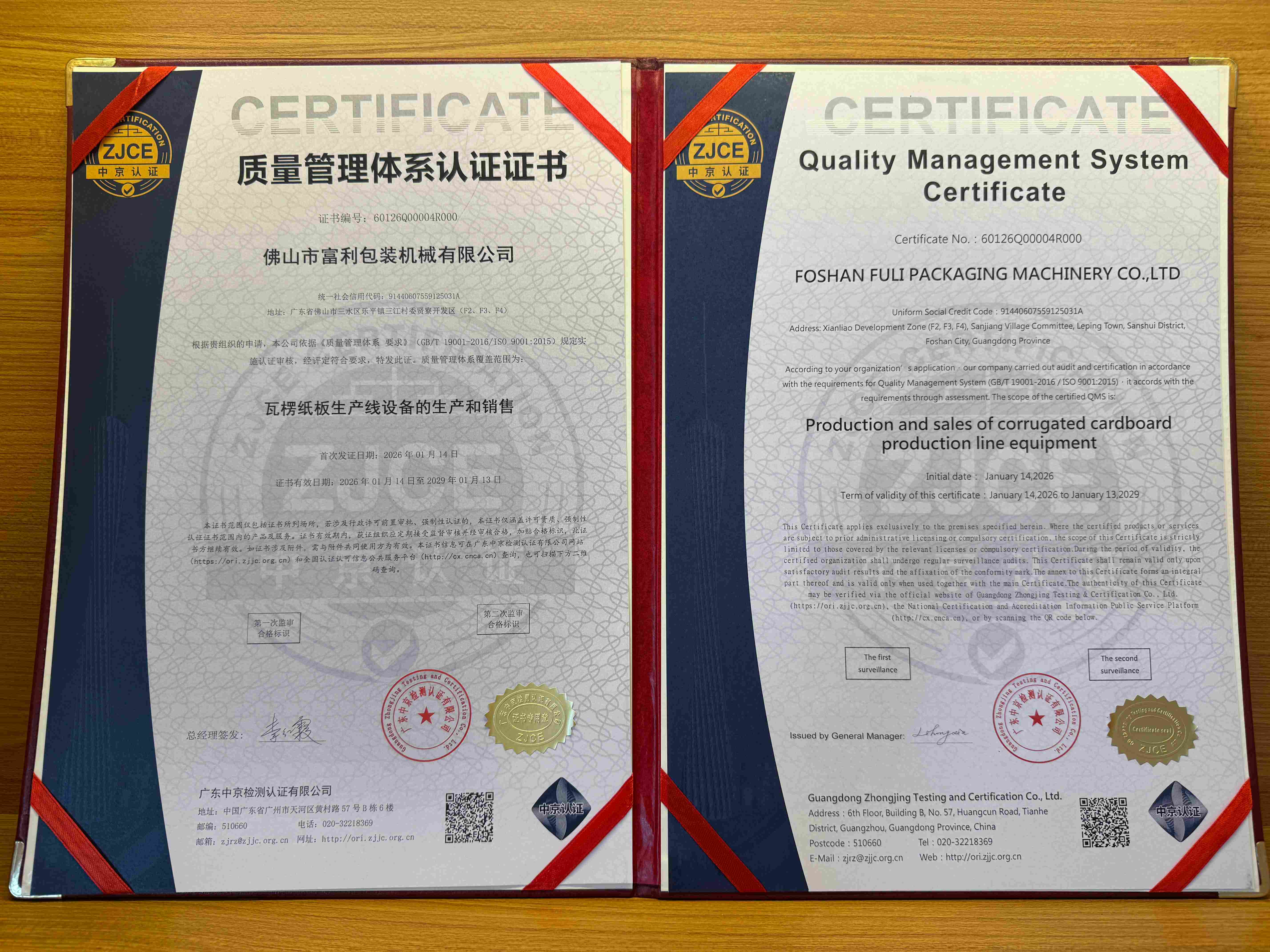
LLY PACK ISO 9001:2015 certification, certificate number 60126Q00004R000, valid until 13 January 2029 and applicable to the global market.
Use Cases: Three Product-Mix Profiles
Profile 1 — Long runs, few sizes, heavy board
A plant producing a narrow family of transport packaging in 5-ply and heavier grades, running the same widths for hours at a time, is the natural home for a dedicated slitter scorer such as the SSC-1. Changeovers are infrequent, so repositioning speed buys little, while score consistency across a long run protects yield and keeps the folder gluer and stitcher fed with predictable blanks.
Profile 2 — High-mix, short-run box plant
A plant serving e-commerce and retail customers with many small orders, frequent width changes and a spread of board grades, gets more value from a thin-blade system, provided the setup routine is standardised, verified after every change, and supported by a spare blade set on site. In this profile the cost of a slow changeover is measured in lost line minutes rather than in blade cost.
Profile 3 — Mixed book with a long-run core
Most plants sit here: a stable core of repeat sizes plus a long tail of one-offs. The practical answer is usually to batch the core into dedicated runs and treat the tail as a scheduled campaign, rather than to buy one head that compromises both. Before adding a second head, test whether better order sequencing removes most of the changeover pain; it often does, and it costs nothing.
Reference installation
LLY PACK reports a reference project for a corrugated paper carton manufacturer operating across Myanmar, Indonesia, Thailand, Turkey, Egypt, Singapore, Vietnam and Jordan. The project covered 9 units over a 10-year relationship and resulted in a complete corrugated carton production line built from scratch for the customer, with fully automatic production as the operating highlight. The application conditions listed for this type of project are high precision requirement, high continuity and high speed, with base paper adaptability and speed synchronisation named as the special requirements for line parts matching. Those conditions are precisely where slitter scorer choice stops being a detail.
Comparison Table: SSC-1 vs Thin-Blade Systems
The table below separates verified LLY PACK facts from general category characteristics that must be confirmed supplier by supplier.
| Decision checkpoint | SSC-1 slitter scorer (LLY PACK) | Thin-blade system (verify per supplier) |
|---|---|---|
| Product identity | Slitter scorer, model SSC-1, supplied by LLY PACK as part of its corrugated cardboard production line offering | Category of slitting and scoring head using narrow circular blades and matched score rings; model and configuration vary by supplier |
| Best-fitting order profile | Repeat sizes, long runs, batched width sequences | High-mix, short runs, frequent width changes |
| Changeover logic | Positions held for a defined size set; fewer verification steps per change | Individual positions repositioned per order; speed depends on setup discipline |
| Score consistency on heavy board | Designed for stable score geometry across a long run; confirm on your heaviest grade at acceptance | Requires score depth and position verification after each repositioning |
| Consumables | Score rings and slitting edges wear; spare set recommended in quotation | Thin blades are consumables with a defined regrind or replacement cycle |
| Line fit | Listed within a line that LLY PACK reports at 1400–2800 mm width and 300 m/min maximum mechanical speed; confirm SSC-1 usable deckle against your own width | Must be matched to the host line's width and speed by the system supplier |
| Downstream constraint | Sheet width must be receivable by the stacker; the STA-1 accepts 1400–2300 mm paper width | Same constraint applies; check cut-off and stacker limits first |
| Documentation | Covered by LLY PACK ISO 9001:2015 certification 60126Q00004R000, valid until 13 January 2029 | Request the supplier's own quality documentation and acceptance record |
FAQ
What certification should I verify before ordering a slitter scorer?
Verify the supplier's quality management certification and then verify the machine itself. LLY PACK holds ISO 9001:2015 certification under certificate number 60126Q00004R000, issued by Guangdong Zhongjing Testing and Certification Co., Ltd., against the standard GB/T 19001-2016/ISO 9001:2015. The certification is applicable to the global market and valid until 13 January 2029. Because ISO 9001 addresses the quality management system rather than the cutting performance of an individual unit, pair the certificate with the signed model datasheet and a factory acceptance record showing width and score results on your own board grades.
Can the SSC-1 be matched to different line widths and downstream equipment?
The slitter scorer must be quoted against your usable width, not against a general envelope. LLY PACK reports production line widths of 1400–2800 mm for its corrugated line, and lists the slitter scorer as a named unit in that line configuration together with the cut-off and stacker. The downstream stacker sets a second limit: the STA-1 accepts paper widths of 1400–2300 mm, a maximum paper length of 3.5 m and a maximum paper height of 1.8 m. Ask for the SSC-1 working width range and overall dimensions on the datasheet, then confirm both the cut-off and the stacker can handle the widest sheet you intend to run.
What drives the cost difference between a dedicated slitter scorer and a thin-blade system?
Configuration drives cost more than architecture. The variables that move a quotation are the number of slitting and scoring positions, the control and positioning hardware, the spare blade or score ring set, and the acceptance scope. Operating cost then depends on your own numbers: changeover minutes per shift, blade and ring replacement frequency in your running pattern, and the trim waste or rework generated by out-of-tolerance sheets. Request an itemised quotation that separates the head, the spare set and the commissioning scope, so the two options can be compared on the same basis.
Can we test our own board before committing to a configuration?
Yes, and it should be a condition of the order. LLY PACK lists base paper adaptability and speed synchronisation as the special requirements for corrugated cardboard line parts matching, which makes your own paper grades the relevant test material. Supply the heaviest and the lightest grade in your mix, specify the score depth, score width and position tolerance you accept, and ask for the results in writing. LLY PACK can arrange a board sample test and a configuration-based quotation for the SSC-1; you can reach the team through www.llypack.com or by requesting the product catalogue below.
How are delivery, installation and commissioning scheduled?
Delivery and commissioning are configuration-specific, so they should be fixed in the purchase order rather than assumed from a brochure. Ask for the schedule to cover four items in writing: the machine build and delivery dates, the installation and commissioning responsibilities, operator training at the head, and the spare blade or score ring set shipped with the unit. Treat the spare set as part of the delivery scope, because a blade change without a spare on site becomes an unplanned stop. Once those four items are confirmed, the two architectures can be compared on total time to first good sheet, not on machine price alone.
Conclusion: Decide on Changeover Minutes, Then Verify on Paper
The SSC-1 and thin-blade systems are not competing answers to the same question. The dedicated slitter scorer converts repeat sizes into yield: fewer verification steps, stable score geometry, predictable blanks at the folder gluer and stitcher. Thin-blade systems convert a fragmented order book into uptime: rapid repositioning, provided the setup is standardised and a spare blade set is on the shelf.
Make the decision in this order. Profile the order book by width and grade. Confirm the usable deckle range against the line width and the downstream stacker. Set the speed requirement from the output you must ship, then compare it with the line's reported speed. Specify score tolerances grade by grade. Only then compare quotations, and require the acceptance test on your own board. LLY PACK reports more than 3,500 corrugated line installations and a manufacturing facility in Foshan equipped with 4 sets of advanced CNC centers from Japan, supported by more than 100 patent rights and industry certificates. Those capabilities matter, but they matter after the changeover arithmetic is complete.
Next Step: Get the SSC-1 Datasheet and a Board Sample Test
Send us your order profile, board grades and required sheet widths. LLY PACK will confirm the SSC-1 configuration, the usable deckle range, the spare blade and score ring set, and a configuration-based quotation.
Contact: Christina | Email: christina@lycorrugated.com | WhatsApp: +86 13763260555
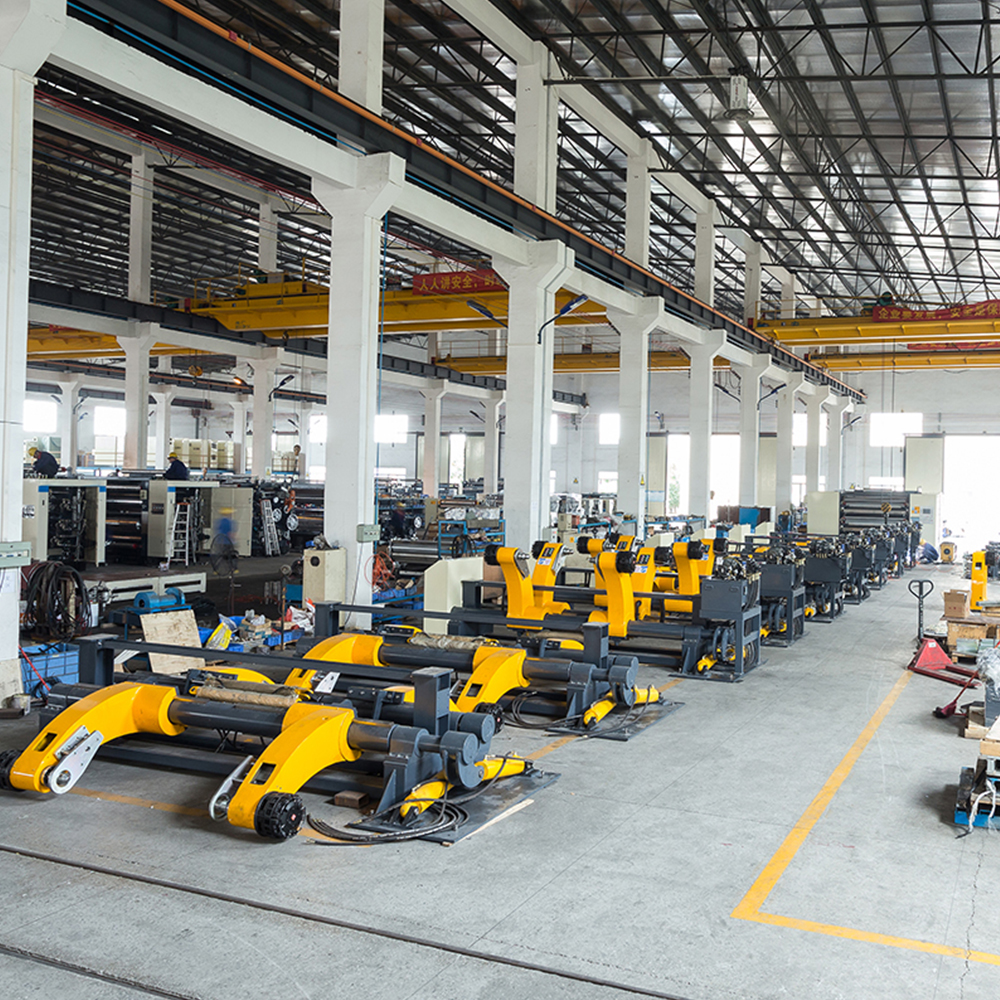
LLY PACK manufactures corrugated machinery in Foshan, Guangdong, China, and exports to customers worldwide.
Have Questions or Need More Details?
Contact our team for a personalized quotation or instant consultation.
Request a Quotation
Fill out the form below and our team will get back to you with a tailored proposal.
WhatsApp Direct Chat
Prefer to chat in real-time? Message us on WhatsApp for instant assistance & quick answers.
- Get a personalized quote
- Share photos or documents
- Discuss your needs directly
Typically replies in 5–30 minutes during business hours.