
Top 7 Essential Machines for a High-Efficiency Corrugated Box Plant in 2026
Top 7 Essential Machines for a High-Efficiency Corrugated Box Plant in 2026
Seven machines decide how much board and how many boxes a corrugated plant can ship per shift. They are ranked below in the order they constrain one another — from the reel stand that feeds raw paper to the conveyor that stacks finished bundles — because in a corrugated line, sequence is the constraint.
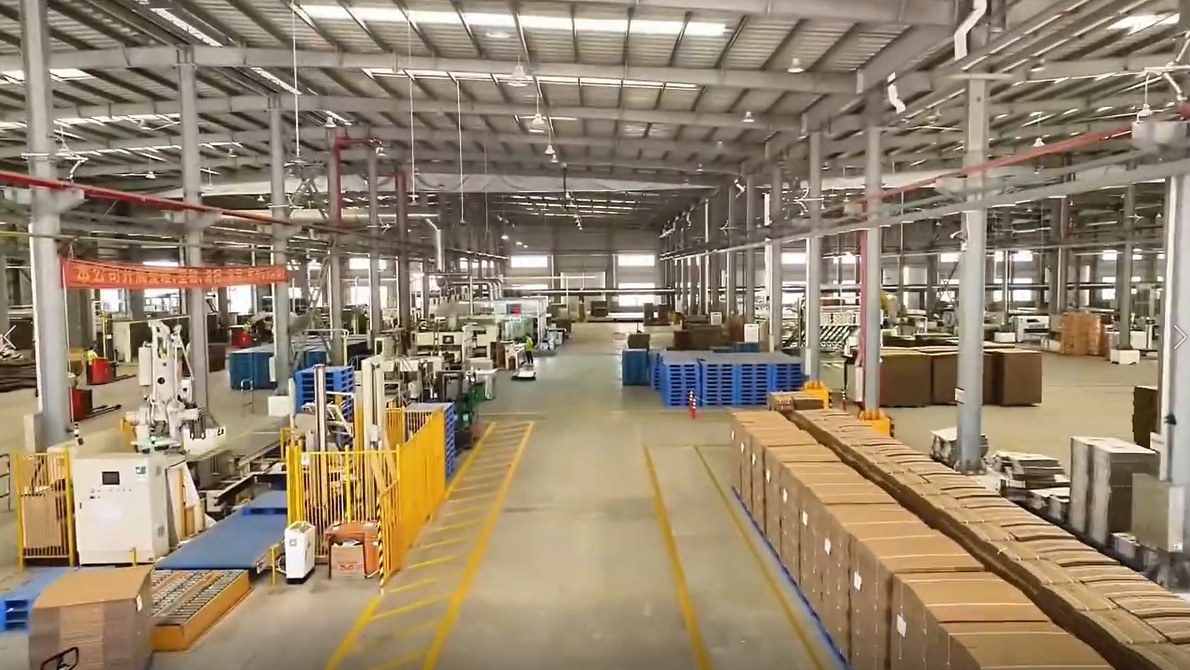
A carton factory floor: the seven machines below determine how much board and how many boxes leave this space each shift. Image: LLY PACK.
This guide is written for plant owners, procurement managers, and project engineers who are either building a corrugated box plant from scratch or replacing part of an existing line. Every ranking position below is backed by published machine specifications — working widths, speeds, sheet sizes, and electrical requirements — so you can compare what each unit actually does against your own job mix instead of relying on general claims.
The reference equipment set comes from LLY PACK (HK) CO., LIMITED, a corrugated machine manufacturer headquartered in Hong Kong with a manufacturing base in Foshan City, Guangdong Province. LLY PACK has over 25 years of experience in corrugated machines and high-speed corrugated cardboard production lines, exports to more than 40 countries, and reports more than 3,500 corrugated line installations worldwide.
Problem Definition: Why Single-Machine Purchases Break a Corrugated Line
The most common planning mistake in a corrugated box plant is buying machines one at a time, by budget or by vendor relationship, and assuming the line will average out. It does not. The line runs at the rate of its slowest station, and a single mismatch propagates in three predictable ways.
Speed mismatch. A pre-feeder running at 280 sheets per minute cannot keep a downstream station designed for 350 sheets per minute at full output; the buffer between them empties and the printer starves. Speed synchronization is a design requirement of corrugated cardboard production, not an operating detail.
Size mismatch. Machines are built around a working envelope. When a plant accepts a large-format job that exceeds the maximum sheet size of its feeder or printer, the job must be handled manually or outsourced. Conversely, a machine sized far above the plant's real job mix wastes floor space and utilities.
Process and utility mismatch. Corrugated lines operate in semi-automatic or fully automatic mode, and each mode implies different labor, safety, and material-handling requirements. Utilities are equally binding: steam pressure, boiler capacity, voltage, and frequency must match before the first reel is loaded. The Paper Reel Cutter specification, for example, notes a 50–60 Hz frequency that is customizable by market — an indication of how much a plant's electrical supply can constrain an otherwise suitable machine.
Project scenarios also carry requirements that are easy to overlook until commissioning: in high-precision, high-continuity, high-speed corrugated environments, base paper adaptability and speed synchronization are consistently listed as special requirements. Those two factors — raw material variability and inter-machine timing — are where new plants most often lose output.
Industry Background: What the 2026 Corrugated Machinery Market Rewards
The commercial case for getting the machine set right has strengthened. The global corrugated box making machine market was valued at USD 2.21 billion in 2024 and is projected to reach USD 3.36 billion by 2033, a 4.8% CAGR from 2025 to 2033 (Grand View Research). Within China, the corrugated box machine industry is projected to rise at a 3.9% CAGR between 2026 and 2036, driven by the country's role as a global manufacturing hub (Future Market Insights).
Automation is the clearest structural shift behind those numbers: automatic corrugated machines hold a dominant 55.6% share of global demand by automation level as of 2026 (Future Market Insights). For plant planners, the practical reading is straightforward — the equipment mix that competes in 2026 is an automated one, and manual handling is increasingly the margin a plant loses rather than the cost it saves.
Compliance expectations are tightening in parallel. ISO 3037:2022 and the FEFCO GMP standard are the primary global references for corrugated board quality and edgewise crush resistance, while corrugated printing and converting machinery sold into the EU must carry CE marking and follow standards such as EN ISO 12048 for compression testing. Buyers who treat certification as a checklist item rather than a design input usually discover the gap late, when a machine is already on the floor.
The Top 7 Machines, Ranked by Production Dependency
The ranking below follows material flow rather than price or prestige. Position 1 sets the widest web and the reel-change rhythm; each subsequent machine inherits those limits, and position 7 converts everything upstream into a shippable pallet. Read as a set, these seven units cover a complete corrugated cardboard production line. The supporting equipment that surrounds them — glue kitchens, waste paper balers, strapping and wrapping machines, reel cutters, and testing instruments — is covered after the ranking.
1. HRS-1 Hydraulic Reel Stand — the throughput ceiling
A shaftless hydraulic mill roll stand is the first constraint in the plant because it defines how wide the corrugator can run and how quickly a spent reel can be exchanged for a new one. The HRS-1 is a hydraulic shaftless mill roll stand with a specification range of 1400 mm to 2800 mm, handling paper rolls from 300 mm to 1500 mm in diameter, driven by a 3.7 kW motor.
Model: HRS-1 · Type: Hydraulic Shaftless Mill Roll Stand
Power: 3.7 kW
Specification range: 1400 mm – 2800 mm
Paper roll diameter: min 300 mm / max 1500 mm
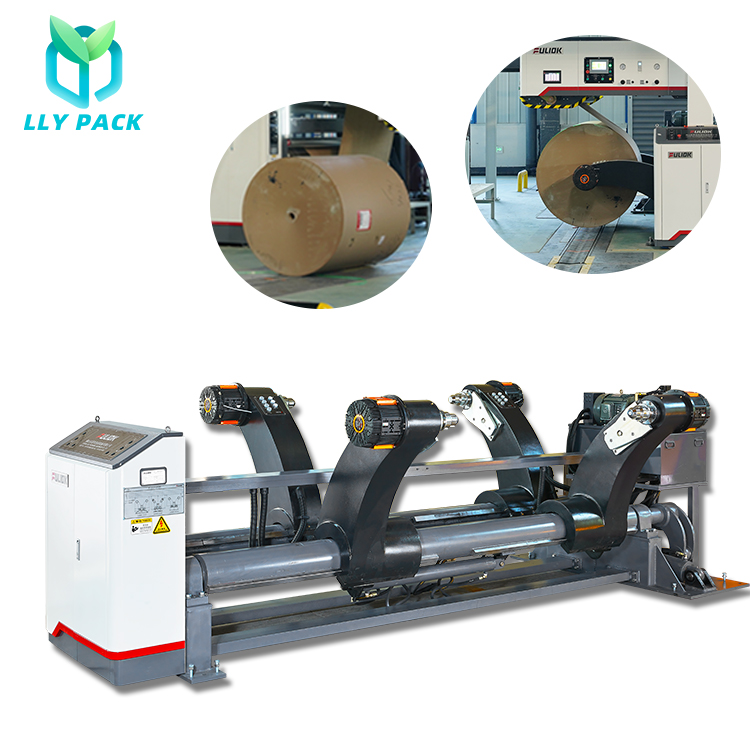
HRS-1 hydraulic reel stand: 1400–2800 mm specification range, paper roll diameter 300–1500 mm, 3.7 kW.
Why it ranks first: every downstream width limit is inherited from this unit. If the reel stand accepts 2800 mm but the single facer is built for 2300 mm, the plant pays for capacity it can never use.
2. SF-1 Single Facer — where board quality is fixed
The single facer forms the flute, applies glue, and bonds the medium to one liner, producing the single-faced web that everything downstream is built on. Flute height consistency, glue-line control, and web tension are all set here, which is why board complaints — warping, poor flatness, weak edge crush — usually trace back to this station.
Model: SF-1 · Type: Corrugated Machine (Single Facer)
Design speed: 250 m/min
Roll diameters: upper flute 380 mm · lower flute 380 mm · pressure roll 385 mm · glue applying roll 302 mm · doctor roll 170 mm · preheating roll 400 mm
Web size: 1400 – 2300 mm · Dimensions: 5900 × 2300 × 2800 mm
The 250 m/min design speed is the figure to hold against your target output when the unit is specified — not the highest number printed on a line brochure. Board quality tolerances are set at this station and then inherited by every converting machine after it.
3. SSC-1 Slitter Scorer — dimensions and squareness
Slitting and scoring determine whether a sheet folds into a square box or one that has to be forced. A thin-blade slitter scorer cuts the moving web to width and presses the fold lines in a single pass, so blade condition and score-depth consistency show up directly in box squareness and in how the stitcher performs downstream.
Model: SSC-1 · Type: Thin Blade Slitter Scorer Machine
Production capacity: 630 – 900 m/min · Power: 30.3 kW · Weight: 4000 kg
Max paper width: 2200 mm · Min slitting width: 150 mm
Slitting blade OD: 260 mm · Scoring wheel OD: 190 mm
Voltage: 380 V, 110 V, 220 V, 440 V · Dimensions: 4230 × 1630 × 2150 mm
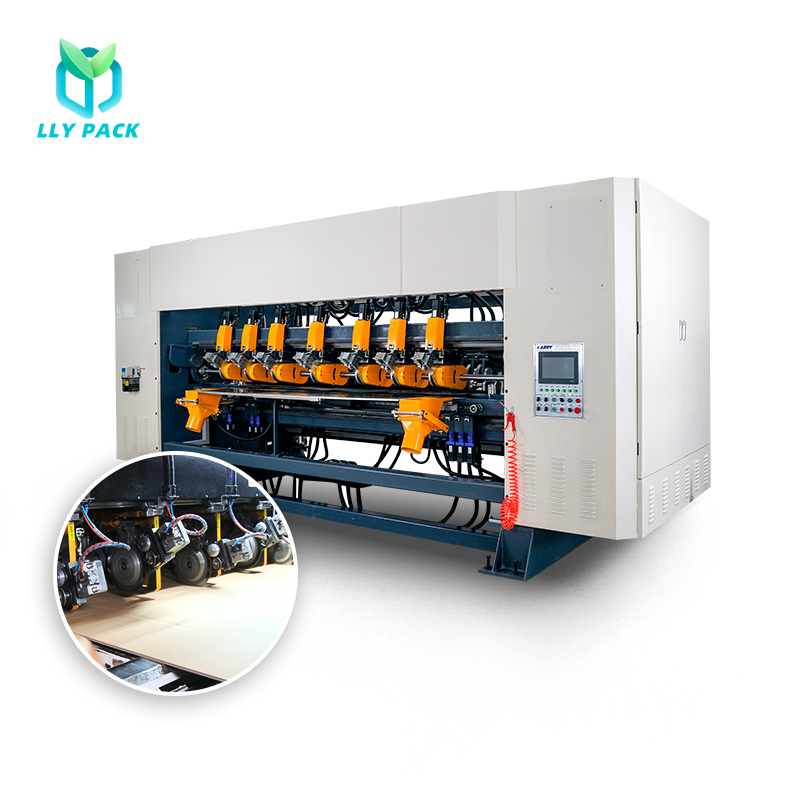
SSC-1 thin blade slitter scorer: 630–900 m/min line speed, maximum paper width 2200 mm.
The 630–900 m/min line speed keeps this unit ahead of the corrugating stage rather than behind it. The multi-voltage options matter for importers as well: a machine that matches the destination grid avoids a transformer on the plant floor.
4. PF-1 Automatic Pre-Feeder — the bridge between corrugator and printer
Once board is cut into sheets and stacked, someone has to move those stacks into the printing and slotting station at a steady rate. Manual feeding sets that rate at human speed and adds handling damage. The PF-1 automatic pre-feeder lifts the stack, aligns it, and feeds sheets continuously at up to 280 sheets per minute.
Model: PF-1 · Type: Automatic Pre-Feeder Corrugated Sheets Feeding Machine
Max paper feed speed: 280 sheets/min · Power: 13.7 HP
Sheet size: max 1600 × 3000 mm · min 300 × 600 mm
Max feeding weight: 1600 – 1800 kg · Max stacking height: 1800 mm · Fork length: 1600 – 1800 mm
Dimensions: 12267 × 4615 × 2395 mm
PF-1 automatic pre-feeder: 280 sheets/min, sheet range 300 × 600 mm to 1600 × 3000 mm.
Why it earns a top-five position: the pre-feeder decides whether the printing station runs continuously or in bursts. A 280 sheets/min feed rate with a 1600 × 3000 mm maximum sheet size means large-format work can be fed automatically rather than by two operators and a forklift.
5. FP-1 Flexo Printer Slotter — print and slot in one pass
Printing and slotting are the value-adding stages of a box plant: the sheet is printed with the customer's artwork and slotted to create the flaps. Combining both functions in one unit reduces sheet handling and register loss between operations.
Model: FP-1 · Type: Flexo Printer Slotter
Max equipment speed: 350 sheets/min
Feed size: max 1600 × 3600 mm · min 200 × 435 mm
Skip feeding: 1900 × 3600 mm or customizable
Max printing size: 1600 × 3560 mm · Max slotting depth: 400 mm · Weight: 5000 kg
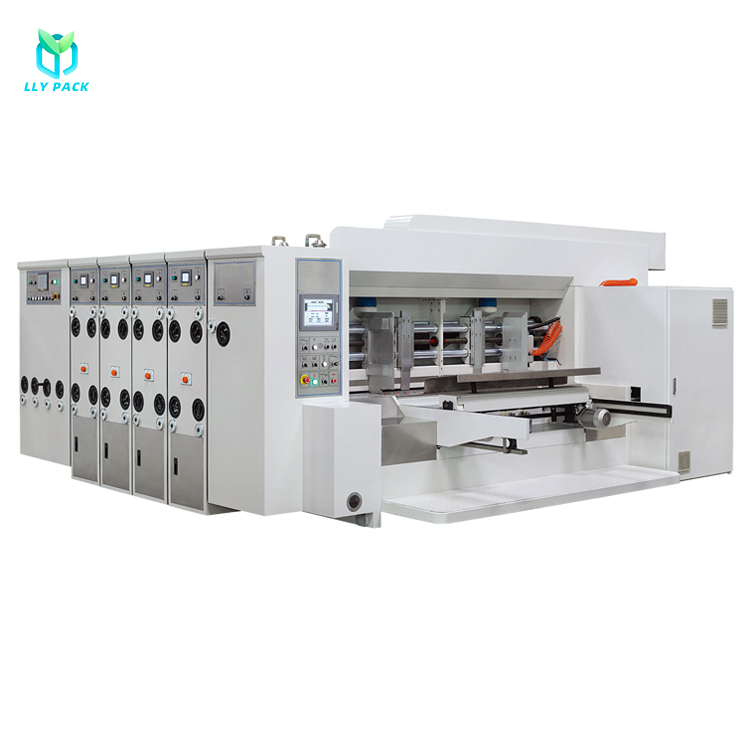
FP-1 flexo printer slotter: 350 sheets/min, maximum printing size 1600 × 3560 mm.
The range from a 200 × 435 mm minimum to a 1600 × 3600 mm maximum feed covers small retail cartons and large-format shipping boxes on the same machine. The skip-feeding option at 1900 × 3600 mm is a customization point worth confirming early, because it changes the handling geometry of the print unit.
6. STM-1 Stitching Machine — closing the box at 450 nails per minute
Stitching is the closing method for many corrugated box formats, particularly double-piece and heavy-duty boxes. Where a folder gluer handles folding and gluing, a stitcher forms the joint mechanically — faster to set up on short runs and more tolerant of thicker board combinations.
Model: STM-1 · Type: Semi Automatic Double Piece Stitcher Machine
Speed: 450 Nails/Min · Stitching pitch: 30 – 140 mm · Number of stitching: 1 – 99
Voltage: 220 V / 380 V · Weight: 500 kg · Dimensions: 4000 (L) × 3300 (W) mm
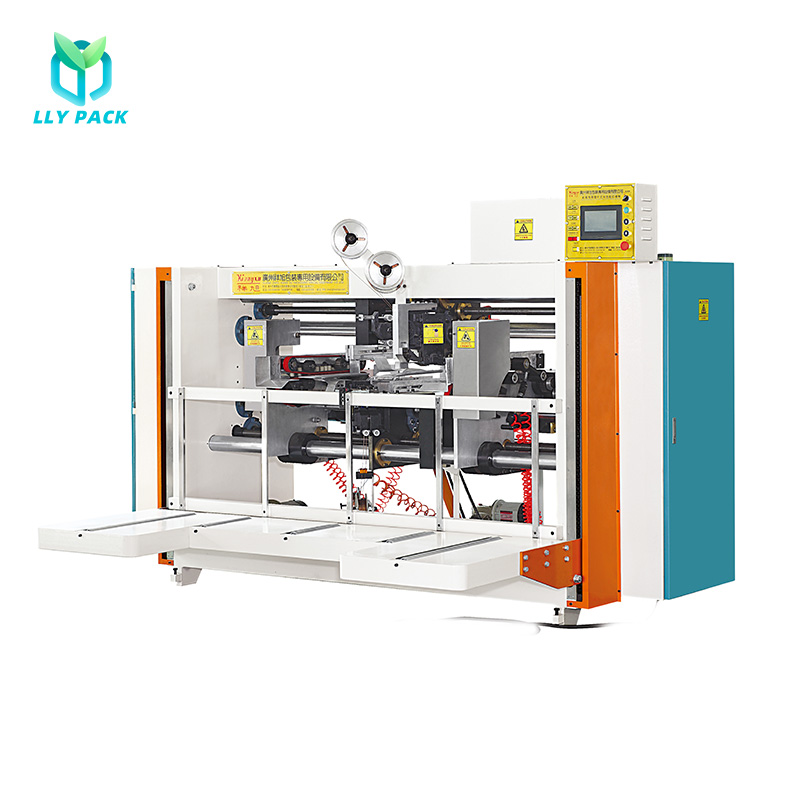
STM-1 double piece stitcher: 450 nails/min, stitching pitch 30–140 mm, 1–99 stitches.
The 450 nails/min speed is the output anchor of the finishing end. If the stitcher runs slower than the printer slotter, printed sheets accumulate as work in progress; if it runs faster, it waits. Matching 450 nails/min against the box count per sheet is the calculation that decides how many stitchers a plant needs.
7. CC-1 Cardboard Conveyor — turning output into pallets
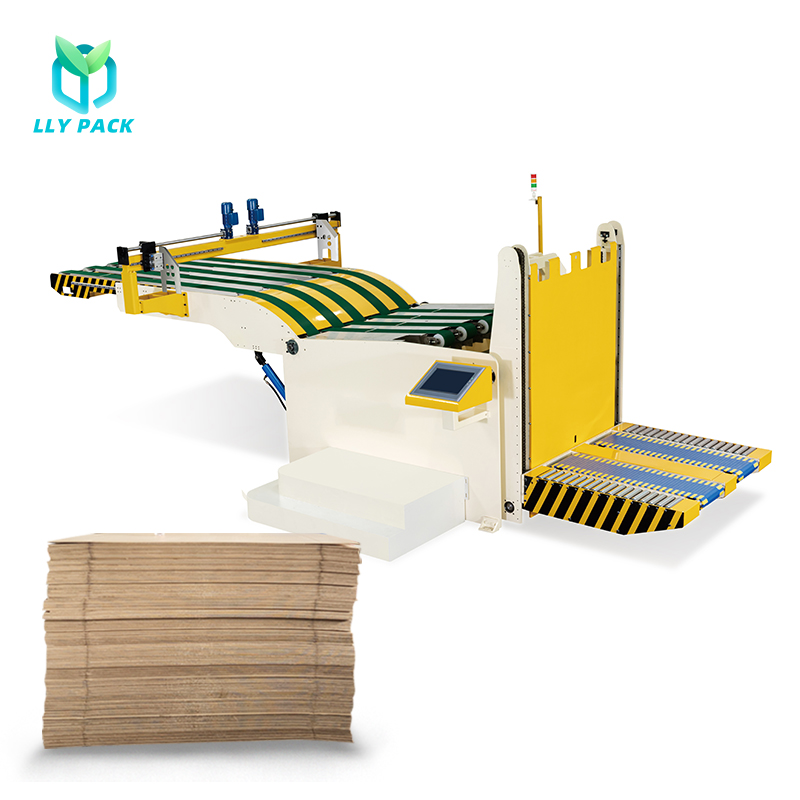
The last machine in the sequence is also the one that decides how many finished bundles leave the plant without a forklift touching them. The CC-1 is a robotic palletizing conveyor that receives bundles from the finishing end, stacks them to a controlled height, and places them on pallets.
Model: CC-1 · Type: Robotic Palletizer / Cardboard Conveyor
Carton size: max 1500 W × 1200 L × 250 H mm · min 350 W × 260 L × 50 H mm
Max bundle weight: 3000 kg · Bundle quantity: 5 – 20 pcs per bundle
Max stacking height: 1800 mm · Max stacking area: 1500 W × 1500 L mm
Pallet store height: 2000 mm · Pallet position precision: 10 mm
Voltage: 380 V / 50 Hz or 220 V / 50 Hz · Dimensions: 6000 × 5000 × 4500 mm (customized)
Ten-millimeter pallet positioning precision is what makes automatic pallet patterns reliable at 3000 kg bundle weights. Below that tolerance, pallets shift during transport and the savings from automating the stacking station are lost at the loading dock.
These seven units form the spine of the line. A working plant adds supporting equipment around them: a corrugator line glue kitchen, paper reel conveyor, paper reel cutter with a 95% paper recycling ratio, waste paper baler, strapping machine, bundle tying machine, wrapping machine, cardboard laminater, and a carton testing instrument for quality checks. They are not optional in practice, but they are not the throughput-determining set.
Step-by-Step: How to Specify the Seven Machines Correctly
The order of decisions matters more than the number of quotations collected. Working through the eight steps below prevents the most expensive category of mistake — a machine that is technically excellent and physically incompatible with the plant around it.
- Define the box range before the machine list. List the smallest and largest sheets your market actually requires. A PF-1 pre-feeder covers 300 × 600 mm to 1600 × 3000 mm; an FP-1 printer slotter covers 200 × 435 mm to 1600 × 3600 mm. If your job mix sits outside a machine's envelope, no amount of tuning brings it back.
- Lock the working width. The reel stand range (1400–2800 mm on the HRS-1), the single facer web size (1400–2300 mm on the SF-1), and the slitter scorer maximum paper width (2200 mm on the SSC-1) must be selected as one set. The narrowest machine defines the plant.
- Match the speed chain. Compare the SF-1 design speed of 250 m/min, the SSC-1 line speed of 630–900 m/min, the PF-1 feed rate of 280 sheets/min, the FP-1 maximum of 350 sheets/min, and the STM-1 stitching speed of 450 nails/min against your target shift output. Speed synchronization is one of the two special requirements consistently attached to high-precision, high-continuity corrugated projects.
- Confirm electrical supply and frequency. This equipment set spans 220 V, 380 V, 400 V, and 440 V, single and three-phase. Frequency is customizable on some units — the Paper Reel Cutter is specified at 50–60 Hz, customizable. Verify grid compatibility at the destination before shipment, not after arrival.
- Plan utilities and floor space. The corrugated cardboard production line is specified with a maximum mechanical speed of 300 m/min, a production line width of 1400–2800 mm, steam heating at 10 KG/CM2 steam pressure, a boiler sized at 2, 3, or 4 MT/H according to line speed, and a footprint of approximately 110 m (L) × 14 m (W) × 6.5 m (H). Steam, boiler, and space are project inputs, not afterthoughts.
- Decide the automation level. Corrugated lines run in semi-automatic or fully automatic mode. Automatic machines hold 55.6% of global demand by automation level as of 2026, so the semi-automatic option is now a deliberate choice about labor availability and capital rather than a default.
- Verify base paper adaptability. The second recurring special requirement in corrugated project scenarios is base paper adaptability — the machine set's ability to run the liner and medium grades you can actually buy. Liner GSM ratings on the Automatic Splicer, for example, run from 50 g/㎡ to 350 g/㎡, a published range to check against your paper supply rather than assume.
- Build a quality check into the line, not after it. The CTI-1 carton testing instrument measures burst strength from 250 to 5600 kPa, crush resistance from 60 to 3000 N, and thickness from 0.01 to 60 mm, with ±0.5% FS / 0.005 mm accuracy and platen parallelism below 0.05 mm. A testing routine tied to these parameters turns customer complaints into machine settings.
Scenario Fit: Where This Machine Set Is Already Running
The seven-machine configuration is not theoretical. In one documented project, a corrugated paper carton manufacturer commissioned nine units to build a complete corrugated carton production line from scratch, with the result reported as fully automatic production. That project relationship has run for ten years, and the equipment is in service across Myanmar, Indonesia, Thailand, Turkey, Egypt, Singapore, Vietnam, and Jordan.
The wider scenario profile covers projects in Mexico, Argentina, Brazil, Belarus, Côte d'Ivoire, Colombia, Dominica, Algeria, Egypt, Hong Kong, Indonesia, India, Kenya, Morocco, Malaysia, Saudi Arabia, Thailand, Turkey, Uganda, and Vietnam. The common project type is corrugated cardboard line parts matching — fitting new or replacement units into an existing line — and the function is consistent across all of them: converting raw paper into corrugated cardboard that meets specification.
Two operating conditions repeat across these projects: high precision, high continuity, and high speed; and specific requirements around base paper adaptability and speed synchronization. Both point to the same planning conclusion. The value of a machine set is not in any single unit's headline number, but in whether the seven units hold a common tolerance band under the paper grades the plant actually buys.
Comparison Table: The Seven Machines Side by Side
The table below compares the seven machines on the specification that most directly limits plant throughput. All figures are published manufacturer specifications for the models named.
| # | Machine & Model | Line Stage | Key Throughput Specification | Working Envelope |
|---|---|---|---|---|
| 1 | Hydraulic Reel Stand HRS-1 | Reel handling / line front end | 3.7 kW hydraulic drive; shaftless reel change | Specification 1400–2800 mm; roll diameter 300–1500 mm |
| 2 | Single Facer SF-1 | Corrugating | Design speed 250 m/min | Web size 1400–2300 mm |
| 3 | Slitter Scorer SSC-1 | Cutting & scoring | 630–900 m/min line speed | Max paper width 2200 mm; min slitting width 150 mm |
| 4 | Pre-Feeder PF-1 | Sheet feeding to converting | 280 sheets/min | Sheet 300 × 600 mm to 1600 × 3000 mm |
| 5 | Flexo Printer Slotter FP-1 | Printing & slotting | 350 sheets/min | Feed 200 × 435 mm to 1600 × 3600 mm |
| 6 | Stitching Machine STM-1 | Box closing | 450 nails/min | Stitch pitch 30–140 mm; 1–99 stitches |
| 7 | Cardboard Conveyor CC-1 | Stacking & palletizing | Bundle weight up to 3000 kg; 5–20 pcs per bundle | Carton 350 × 260 × 50 mm to 1500 × 1200 × 250 mm |
Read vertically, the table shows why the ranking is a dependency chain rather than a preference list: the envelope in row 1 sets the maximum width available in rows 2 and 3, the sheet sizes in rows 4 and 5 are bounded by what the corrugator can produce, and the bundle weights in row 7 are bounded by what rows 5 and 6 can close and hand over.
Frequently Asked Questions
What standards and certifications should corrugated box plant machinery meet for export markets in 2026?
Two separate layers apply, and they should not be confused. For corrugated board quality, ISO 3037:2022 is the primary global standard for edgewise crush resistance, and the FEFCO GMP standard is widely referenced for corrugated cardboard production. For machine safety, corrugated printing and converting machinery sold into the EU requires CE marking and adherence to standards such as EN ISO 12048 for compression testing. A machine can meet a board quality standard and still require its own safety conformity assessment, so buyers should request documentation for the specific unit being purchased rather than assuming a category-level certificate covers it.
Can a complete corrugated box production line be built from these seven machines?
Yes, as a throughput-defining core. The seven units cover reel handling, corrugating, slitting and scoring, sheet feeding, printing and slotting, stitching, and palletizing — the full path from raw paper to a stacked, shippable bundle. In practice a working plant also installs supporting equipment such as a glue kitchen, paper reel conveyor, waste paper baler, strapping and wrapping machines, and a carton testing instrument. LLY PACK specializes in 2 to 9-layer corrugated cardboard production lines, which allows the core set to be configured for single-wall through multi-wall board. The line itself can be operated in semi-automatic or fully automatic mode, so the same machine set supports different labor models.
What are the main cost drivers of a corrugated box production line in 2026?
Five variables move the total more than any other factor. Working width is first: the same machine family spans 1400 mm to 2800 mm, and capacity scales with width. Automation level is second — automatic machines hold 55.6% of global demand by automation level as of 2026, and moving from semi-automatic to fully automatic changes both capital cost and operating labor. Third is the number of units in the line, since feeding, printing, stitching, and palletizing can each be single or duplicated. Fourth is the utility configuration: steam heating at 10 KG/CM2 with a boiler sized at 2, 3, or 4 MT/H according to line speed, plus destination-specific voltage and 50–60 Hz frequency requirements. Fifth is customization, including options such as skip feeding (1900 × 3600 mm or customizable) and customized conveyor dimensions. Quotations should be compared against these five variables, not against a headline price.
How can we validate machine performance before committing to a full line?
Validate against your own job mix rather than a general demonstration. Start with your smallest and largest sheets and check them against the published envelopes — for example, the PF-1 pre-feeder accepts sheets from 300 × 600 mm to 1600 × 3000 mm, and the FP-1 printer slotter accepts 200 × 435 mm to 1600 × 3600 mm. Then check the speed chain: 280 sheets/min feeding, 350 sheets/min printing and slotting, 450 nails/min stitching. Board quality can be verified with the CTI-1 carton testing instrument, which measures burst strength from 250 to 5600 kPa, crush resistance from 60 to 3000 N, and thickness from 0.01 to 60 mm, with ±0.5% FS / 0.005 mm accuracy. Because validation arrangements depend on the specific machine and the paper grades you intend to run, they should be confirmed directly with the manufacturer before the order is placed.
What affects delivery and commissioning time for a corrugated line?
Delivery and commissioning time is driven by order scope, machine width, automation level, customization, and destination. A single replacement unit and a full seven-machine line follow different schedules, and a customized unit — a conveyor with non-standard dimensions or a printer with skip-feeding geometry — adds engineering time before production begins. What reduces schedule risk is supplier execution history rather than a quoted number: LLY PACK has over 25 years of experience in corrugated machines and high-speed corrugated cardboard production lines, exports to more than 40 countries, and reports more than 3,500 corrugated line installations worldwide, including a nine-unit line built from scratch for a corrugated paper carton manufacturer in a project relationship that has run for ten years. To get a schedule tied to your actual project, send your sheet size range, target output per shift, and destination port to the LLY PACK team — Christina, christina@lycorrugated.com, WhatsApp +86 13763260555 — and request the full product catalog as a starting point.
Conclusion: Rank the Constraints, Then Buy the Machines
A high-efficiency corrugated box plant in 2026 is assembled around seven throughput-defining machines: the HRS-1 hydraulic reel stand, the SF-1 single facer, the SSC-1 slitter scorer, the PF-1 automatic pre-feeder, the FP-1 flexo printer slotter, the STM-1 stitching machine, and the CC-1 cardboard conveyor. Each carries a published working envelope and speed rating, and those numbers — a 2800 mm maximum reel specification, a 250 m/min single facer design speed, 630–900 m/min slitting, 280 sheets/min feeding, 350 sheets/min printing, 450 nails/min stitching, and 3000 kg bundle handling — determine whether the seven units behave as a line or as seven separate machines.
The planning sequence is therefore fixed: define the box range, lock the working width, match the speed chain, confirm utilities and electrical supply, decide the automation level, and verify base paper adaptability. Buyers who work in that order spend their budget on throughput. Buyers who work in reverse spend it on compatibility fixes.
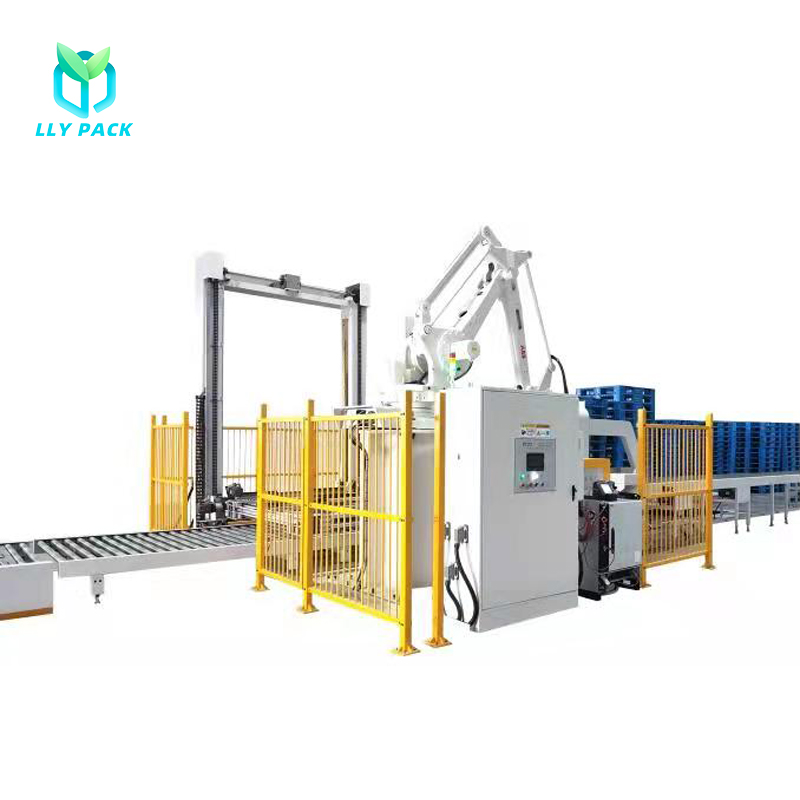
CC-1 cardboard conveyor: bundle weights to 3000 kg, stacking height 1800 mm, pallet position precision 10 mm.
Next Step: Match the Seven Machines to Your Project
Send us your target sheet size range, required output per shift, and destination market, and the LLY PACK team will map the seven machines to your production scenario — including base paper adaptability and speed synchronization checks for the paper grades you intend to run.
Download the full product catalog: LLY PACK Corrugated Machine Catalog (PDF)
Contact: Christina · christina@lycorrugated.com · WhatsApp +86 13763260555 · www.llypack.com
Have Questions or Need More Details?
Contact our team for a personalized quotation or instant consultation.
Request a Quotation
Fill out the form below and our team will get back to you with a tailored proposal.
WhatsApp Direct Chat
Prefer to chat in real-time? Message us on WhatsApp for instant assistance & quick answers.
- Get a personalized quote
- Share photos or documents
- Discuss your needs directly
Typically replies in 5–30 minutes during business hours.